Mining never stops, and neither should visibility. In this high-risk and high-output sector, lighting is not only infrastructure but also a driver of productivity and a facilitator of safety. The selection of appropriate lighting towers in mining has a direct impact on operational efficiency, worker safety, and the cost in the long term.
The most common question most mining operators have to answer is: Will you invest in heavy-duty lighting towers that are designed to be enduring, or will you invest in portable lighting towers that are designed to be flexible? The answer isn’t always straightforward, and that’s exactly what we’ll explore in this blog.
Understanding the Role of Lighting in Mining
Poor lighting in mining settings may cause delays, accidents, and decreased accuracy of operation. It could be nighttime excavation or early morning drilling; lighting towers ensure power illumination and consistent visibility.
Contemporary lighting systems have changed a lot. The current systems are not only about brightness but are designed to be fuel-efficient, sustainable, and flexible. This is where the distinction between heavy-duty and portable systems becomes critical.
Also, the lighting tower market is booming worldwide, especially in the mining and infrastructure industries. The latest industry study estimates that the market will be worth USD 3.67 billion in 2033 as a result of the implementation of energy-saving and hybrid systems. This change is a part of a larger trend: mining firms are no longer merely investing in performance, but are making cost optimization and long-term value core priorities.
Heavy-Duty Lighting Towers
These towers are normally mounted in a fixed location, and they are utilized to illuminate large spaces over a lengthy time period.
The most distinguishing factor is that they are extremely powerful. They have large mast heights and intense LED arrays, which can take up large areas such as haul roads, drilling sites, and processing areas.
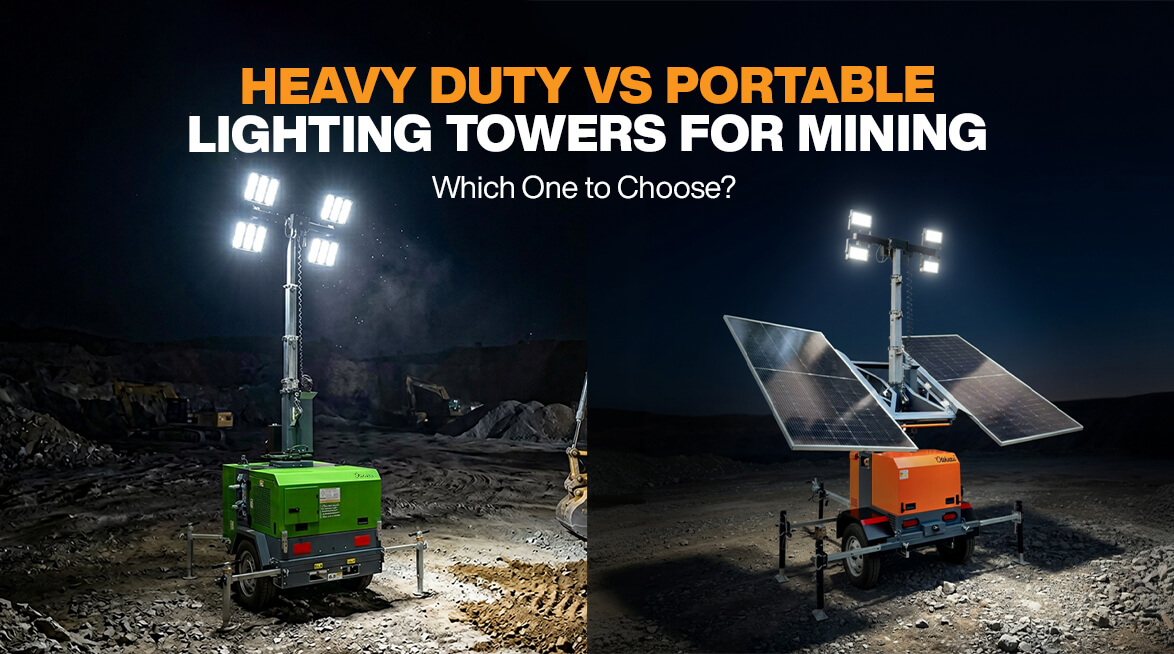
An example is the large-scale systems like Qube Power Max and Qube Grid Max, designed by Olikara to provide high-intensity lighting in a regular way to cover the rough conditions so that their functioning will not be disturbed even in extreme conditions.
Their other feature is that they are durable, and thus can be used in mines. Their performance to cover large areas using fewer units also leads to operational efficiency over time.
Portable Lighting Towers
Portable lighting towers bring a different kind of advantage, that is, mobility. These towers are agile and can follow the changing dynamics of the site in mining operations where work zones change frequently.
Portable towers are small and convenient to carry, unlike heavy-duty systems. They can be put into action within a short period, moved without difficulties, and even adjusted to other parts of the site without interfering with workflow. This renders them especially helpful in areas of exploration, temporary excavations, or on maintenance sites.
Consider Olikara’s small-scale solutions, such as Qube Power Mini or hybrid options such as Qube Solar. These models demonstrate how portability doesn’t mean compromising on performance. Indeed, most of the portable towers today incorporate the latest LED technology and hybrid power, and are extremely efficient and powerful.
Key Differences: Heavy Duty vs Portable Lighting Towers
1. Coverage and Illumination Capacity
The lighting towers are designed to provide high-lumen output in large areas of mining, in many cases over extensive areas with a smaller number of units.
Conversely, portable lighting towers offer medium coverage and therefore are more appropriate in segmented or smaller work areas where focused illumination is viable as opposed to broad-range lighting installation.
2. Flexibility in Mobility and Deployment
Portable lighting towers are engineered to be easily transportable and moved quickly to enable mining teams to adjust lighting according to the change in operations. Heavy-duty towers are more fixed, though, and need to be in a structured location.
This makes portable units the best when it comes to dynamic sites, whereas heavy-duty systems are applicable in fixed and long-term mining areas.
3. Time of Installation and Setting Up of Operations
The more complicated setting up procedures, such as positioning, stabilization, and integration of power, are characteristic of heavy-duty lighting towers. On the other hand, portable lighting towers are designed to be ready to go with minimum setup time.
This distinction is critical in mining conditions where time as well as performance directly influence the productivity and continuity of operations.
4. Energy Efficiency and Power Source
Heavy-duty towers typically are powered by diesel engines or grid power with continuous high-output operation. There is a growing trend of portable lighting towers using hybrid and solar technologies, which lessen the reliance on fuel.
This ensures that portable units are more energy efficient and clean for the environment, especially in mining operations that are oriented towards sustainability and cost-saving.
5. Cost Implications and ROI
Light towers are heavy, durable, and powerful, and can be expensive initially, but in large operations, they can be worth the investment in the long term.
Portable lighting towers cost less in the short run, and this aspect makes them appropriate in short-term or flexible projects where budgets are major factors, and the flexibility of operations is essential.
Which Lighting Tower is a Better Fit and When?
When Heavy-Duty Lighting Towers Make Sense
When your process requires consistency and scale, then heavy-duty systems are the correct choice. They are especially useful in large open mines where the lighting requirements do not change for a long time.
They are also very useful in high-risk areas where maximum visibility is paramount to safety. They can deliver high-intensity, continuous lighting, so the operations are not interrupted, regardless of the weather conditions.
When Portable Lighting Towers Are the Better Fit
Portable lighting towers shine, quite literally, in situations that require flexibility. When your mining location requires the frequent movement of equipment or temporary work zones, these towers are the most convenient available.
They are also a suitable option when using a low budget or short timeline in a project. They are a viable option due to their lower initial investment and the ability to deploy them easily without performance loss.
Conclusion
The question of heavy-duty versus portable lighting towers is not about deciding which one are better, but rather which one best suits your mining operation. Lighting towers with heavy-duty performance are capable of unparalleled performance in large, long-term projects and include portable lighting towers that are flexible and cost-effective in dynamic environments.
Olikara Lighting Towers remains one of the trusted light tower manufacturers and suppliers that can offer reliable and innovative solutions to mining businesses. At Olikara, we offer advanced systems tailored to modern mining challenges.
FAQs
- Which lighting towers would be suitable on large mining sites?
The large sites require heavy-duty lighting towers since they have a wide coverage and are high-intensity.
- Can portable lighting towers be used with continuous mining operations?
They are applicable, although better in temporary or movable zones, than in fixed long-term operations.
- What are the reasons why hybrid lighting towers are popular in mining?
They are cost-effective and sustainable as they reduce fuel consumption and emissions, yet offer good performance.
- How do I choose between different light tower manufacturers and suppliers?
Pay attention to the durability, powering options, after-sales services, and the capability of designing solutions to suit your mining environment, which is what Olikara offers.