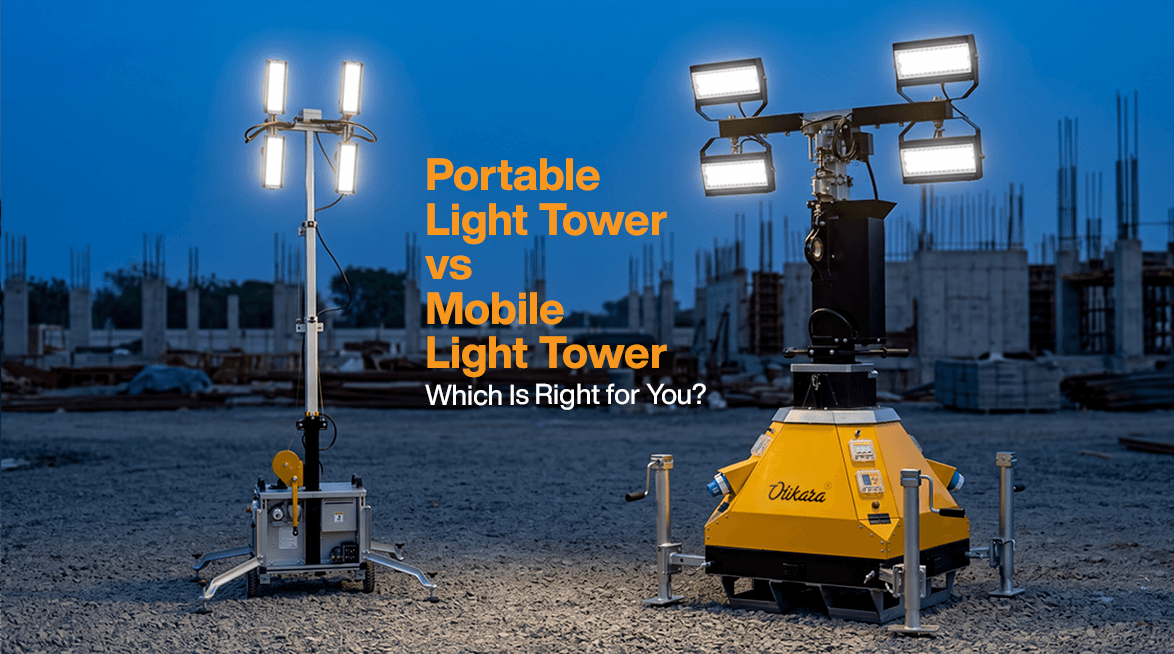
The decision between a portable light tower and a mobile light tower is not a question of which is “better” but rather where, how, and how often illumination is required. Portable towers are typically used for smaller, more temporary job sites, while mobile or trailer-based towers are intended to be used at larger worksites or lighting equipment that need to be moved between locations using towing or material-handling equipment.
Leading portable light tower manufacturers now offer different lighting configurations including solar, engine etc, making the decision as much about the power source as mobility.
Portable vs Mobile Light Towers: What is the Difference?
The terms portable and mobile are sometimes used interchangeably, but they can describe different operational priorities.
The portable light tower is generally designed for ease of deployment. It can be helpful when crews need lighting in a specific work area, have to move it regularly, or operate in relatively small areas. These towers favor compact dimensions, lifting provisions, and simple setup over extensive coverage.
A mobile light tower is designed to be transported easily from one location or worksite to another. Trailer-mounted configurations can be towed, while some designs also incorporate forklift pockets and lifting points for easier handling.
The difference is for construction, mining, infrastructure, and event sites where lighting needs may vary over the course of a project.
Olikara’s Qube Power Mini, for instance, stands 10 feet tall and delivers 360-degree illumination. It is used in applications such as boundary walls, plant maintenance, and emergency services.
For projects that require greater illumination coverage or longer operating periods, larger lighting tower systems may be more appropriate. For example, Olikara’s Qube Grid Base / Trailer is an 8m mast that incorporates four 400W LED lights and has skid and mobile variants. It can also be towed as a trailer configuration or handled via forklift pockets and lifting provisions for site placement.
Portable vs Mobile Light Tower: Comparison
| Factor | Portable Light Tower | Mobile Light Tower |
| Primary advantage | Quick deployment and repositioning | Site-to-site mobility and broader mobility |
| Typical application | Small work zones, maintenance, emergency work | Construction, mining, roads, events |
| Mobility | Manual handling, lifting, or easy relocation | Trailer towing, forklift or crane handling |
| Coverage | Usually suited to localized areas | Often designed for broader illumination |
| Setup | Generally faster for small work areas | Requires positioning |
| Power options | Can be engine, grid or hybrid depending on model | Can also be engine, grid, or hybrid |
One key point to note from the table is that mobility and power source are distinct choices. A mobile tower does not necessarily require diesel power, just as the choice of a portable tower does not determine how it is powered.
When Should You Choose a Portable Light Tower?
Portable lighting makes the most sense when your lighting requirement moves with the work.
Imagine a road maintenance crew is operating on several separate stretches of road during a night shift. A large lighting setup can be installed throughout the site, or a compact tower can be placed in close proximity to the work zone and moved as the work progresses.
The same logic applies to plant maintenance. In the event of a shutdown, lighting around various equipment, access points, or maintenance areas may be needed. A compact tower can be used to illuminate a specific area without the need for a permanent installation.
Also, the mast height, illumination area, run time, and available power infrastructure should also be taken into consideration.
When is a Mobile Light Tower More Useful?
As project size and lighting requirements increase, mobile towers can provide greater flexibility for relocating illumination across different work areas.
Imagine having a highway construction. The equipment may have to travel between work zones, and lighting may need to cover extensive areas. In these situations, towing capability, lifting points, stabilizers, and a robust chassis can have a significant impact on productivity.
For a highway contractor, mobile towers are more convenient than continually shifting smaller units by hand in a wide working area.
Furthermore, the power source matters as much as mobility. The right tower should be chosen based on the site’s energy parameters and physical layout.
- Engine-Powered: Engine towers are important for areas where electricity is not available or reliable. They operate independently, without relying on an outside power source. They are well-suited to larger applications such as mining, oil, highways, dams, bridges, and other major infrastructure projects.
- Grid-Powered: Where reliable electricity is already available, grid-powered lighting can remove the need for fuel-based operation. These towers are suitable for use in construction, events, mine haul roads, and steel plants. Grid-powered configurations also eliminates engine noise and emissions while working.
- Hybrid-Powered: Hybrid systems can be suitable for projects that require both efficient energy use and reliable lighting. They are built for tough applications like mining, oil, and infrastructure projects, where continuous lighting is essential.
Why Safety Should Guide Your Light Tower Decision
Lighting is more than just a means to light up a worksite. Location, coverage, and glare of a lighting system may affect the safety of workers.
This is especially true in the field of road and highway construction. According to the U.S. Federal Highway Administration, roughly half of all fatalities in work-zone crashes took place during nighttime hours. Thus, nighttime work-zone lighting is a component of broader initiatives to make workplaces safer.
More recent data also show why work-zone planning remains important. There were almost 850 work-zone fatalities, less from 905 in 2023.
To contractors, the question should be, “How much light do we need?” It should be, “Where should the light be positioned, how will it move as the work progresses, and can it illuminate the area without creating unnecessary glare?”
What Should You Consider Before Buying?
The most suitable tower is not determined by specifications alone; it also depends on the operating environment and the project’s specific lighting requirements.
Evaluate these factors:
- Access to power: If the site is remote, an engine-driven system may be the best choice, while if there is pre-existing electrical power, a grid-powered system may be possible.
- Required run time: Take into account the duration of each operating shift and how often it is likely to be possible to refuel or recharge.
- Mobility needs: If the tower will need to move several times, check towing, lifting, forklift, and stabilization options.
- Mast height and illumination: A taller mast does not necessarily guarantee better lighting, as illumination also depends on factors such as tower placement, LED type, and the required coverage area.
- Ground and weather conditions: Outdoor towers should be appropriate for the site’s terrain and environmental conditions.
- Long-term value: When the project has a potential for growth or change, a configurable solution may offer better value.
Conclusion
Portable or mobile light towers solve almost the same illumination problem, but they are optimized for different operating conditions. A compact portable unit can be the smarter choice for localized and frequently changing tasks, while a towable or larger mobile system can make more sense for extensive infrastructure, mining, construction, and event applications.
The key is to consider mobility power source, mast height, coverage and runtime, stability, and site conditions.
Olikara Lighting Towers provides lighting tower options across different sizes and power configurations, including engine-powered, grid-powered, and hybrid systems, depending on the application. We help companies choose lighting equipment that suits the practicalities of their worksites, rather than a one-size-fits-all solution.
Ready to choose the right light tower for your project? Contact us now! |
FAQs
1. Are portable and mobile light towers the same?
Not necessarily. Portable towers are known to be easily deployed and moved, whereas mobile towers tend to focus on towing and moving across more expansive sites.
2. Can mobile light towers run on the grid?
Yes. In mobile setups, the grid can provide electricity (where appropriate infrastructure is in place), and the engine can be left off during operation.
3. Which power source is best for remote sites?
When it is not possible to get grid electricity, engine-powered towers become useful. Hybrid systems are recommended if energy efficiency is also an important consideration.

Other Blog