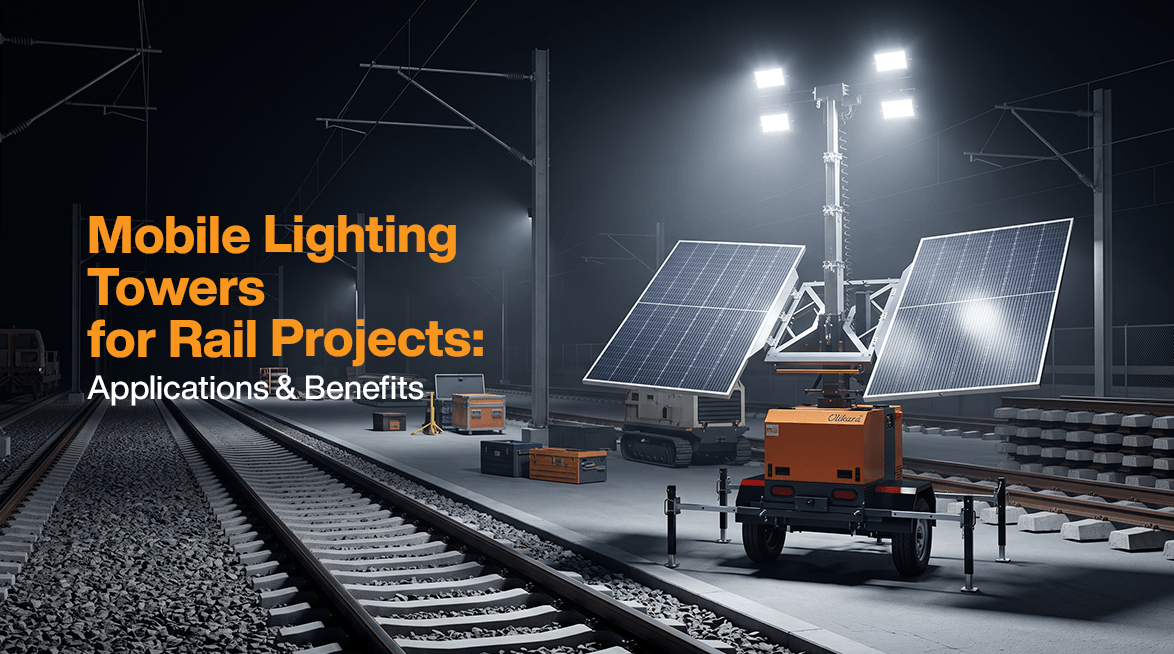
Railway construction and maintenance rarely happen under ideal conditions. Temporary lighting can be an important part of project planning for track possessions, restricted work windows, remote locations, and night-time work schedules.
Mobile light tower manufacturers provide portable light towers which can be used when it is not possible or practical to install permanent lighting. In various railway applications, such as yard maintenance, bridge construction, electrification, and infrastructure works, engine-powered, grid-powered, and hybrid systems can be used, as per the situation and project needs.
Let’s learn more about mobile lighting towers for railway projects.
Why Rail Projects Need Mobile Lighting
A major challenge in railway projects is carrying out construction and maintenance while keeping the railway operational. This requires careful scheduling to minimise disruption to railway operations.
Night work is common for track maintenance, civil construction, signaling, bridge construction, yard operations and infrastructure upgrades. In such cases, lighting is not just about making a site ‘brighter’. It must offer adequate visibility and be easy to transport, install and use.
India’s growing railway electrification and infrastructure development program provides a picture of the scope of the work. According to the Ministry of Railways, Indian Railways electrified 2,701 route kilometers during FY 2024–25, following 7,188 route kilometers in FY 2023–24. As of December 2025, almost 99.2% of the broad gauge network was electrified.
This brings up the interesting lighting challenge that, despite the trend towards electrifying rail infrastructure, individual construction and maintenance sites still require temporary, “stand-alone” lighting.
Key Applications of Mobile Lighting Towers in Rail Projects
Mobile lighting towers are particularly useful for railway work that requires temporary illumination across changing work locations.
1. Railway Yard Maintenance
Railway yards may require lighting across large open spaces after dark for inspection, maintenance, and support work.
Lighting may already be in place in existing yards, but temporary work zones can still need extra lighting. A mobile tower can be moved closer to the immediate work area instead of illuminating the entire yard.
Olikara’s Qube Solar, which uses four 100 W LED lights, a 7-meter mast, and offers stated coverage of up to 2,000 sq. m, can be specifically used for railway yards.
2. Track and Civil Maintenance
Trackside maintenance can involve changing work locations. Crews may need illumination around equipment, access paths, drainage structures, crossings or adjacent civil works.
In such cases, mobility is a more important factor than maximum light output. A tower that can be towed, set up and stabilized at another work site may be more practical than a fixed lighting installation.
You can use medium-duty solutions such as engine-powered towers. They come with almost 8 meters of mast height, along with strong illumination and reliable light coverage for the work area. Their towing capability is also useful for track and civil maintenance work.
3. Bridges, Approaches and Large Civil Structures
For railway bridges, approaches, embankments and related civil works, the lighting requirements can be significantly greater.
For instance, Olikara’s Qube Power Max comes with an 8-meter mast, 4x 350 W LED fixtures and claims coverage of up to 7,500 sq. m. It is suitable for large infrastructure projects and can be towed or crane-lifted, which is an advantage when equipment needs to be transported around a worksite.
A larger tower is not necessarily a better tower. The coverage, mast height, mobility, and operating time of the tower should match the work area.
Engine-Powered vs Grid-Powered vs Hybrid Towers
| Requirement | Engine-Powered | Grid-Powered | Hybrid |
| Remote worksite | Strong fit | Less suitable without grid access | Strong fit |
| Existing electrical supply | Optional | Strong fit | Can be useful |
| Long independent operation | Good fit | Depends on grid | Depends on battery/charging conditions |
| Noise-sensitive location | Less suitable | More suitable | Strong fit |
| Railway yard | Possible to use | Possible to use | Particularly relevant |
| Large infrastructure work | Good fit | Possible to use | Possible to use |
| Fuel dependence | Yes | No | Depends on configuration |
There is no standard power setup for railway tasks. The right choice depends on the availability of electricity, the distance from the site, and the operating time of the light.
Choosing the Right Lighting Power Configuration for Rail Projects
1. When Engine-Powered Towers Make Sense
In situations where electric service is not available, like in construction projects, engine-powered towers are extremely useful.
Think about an alternative remote line, bridge approach, or distant civil construction site. Bringing temporary electrical distribution to every work area can add complexity. Alternatively, an independent tower with its own generator may be used to illuminate as well as supply some electrical power, depending on the configuration.
For example, Olikara’s Qube Power Max falls into this category, featuring four 350 W LED lights and a 170-liter diesel tank, depending on the model. It is claimed to run up to 100 hours. The It’s Qube Power Mini is used for plant maintenance and repairs and uses four 100 W LED lights.
2. When Grid-Powered Towers Make Sense
For cases where electricity is already available, grid-powered is a good option. There may be a suitable grid supply available at railway stations, established yards, workshops and developed infrastructure sites. In these areas, an electric lighting tower can save the fuel storage, fueling, and engine running needed for diesel systems.
An example of this configuration is Olikara’s Qube Grid Base / Trailer. It operates on 230 VAC at 50 Hz and features four 400 W LED lights with up to 6,000 sq. m coverage. Both versions have forklift pockets and stabilizing arrangements, and the trailer version can be towed.
The Qube Grid Max is used for larger areas with 6 x 400 W LED lights and an 11-meter mast with a claimed coverage of up to 8,000 sq. m. It is designed to run on an external electric grid rather than a built-in generator.
3. Where Hybrid Systems Fit
Using a hybrid system makes sense for a project that requires flexibility in engine and also in battery operation.
The Qube Power Max Hybrid is a diesel system and battery storage configuration. In its published configuration, it features a 7.2 kWh battery pack, six 200W LED lights, a 7-meter mast and claimed coverage of 4,000 sq. m. It also offers various operating modes and can switch between power from the generating unit and power from the grid.
Such a system can be useful when power requirements vary across a project, with some work areas requiring an independent temporary power supply while others have access to grid or battery-based power.
Key Benefits
The key benefit mobile lighting offers railway contractors is its versatility. Work fronts change, possession windows shift, and site conditions can vary greatly from one location to another.
The advantages are:
- Mobility: The trailer-mounted configuration can be relocated during the project as the work moves on.
- Temporary deployment: Lighting can be deployed without the need for permanent lighting infrastructure.
- Multiple power options: Engine and grid/hybrid configurations fit a variety of site variables.
- Bright lighting: LED lights can be used for a larger workspace with high masts.
- Operational flexibility: Independent systems can be especially beneficial in areas without temporary electrical systems.
- Transportability: Tow hooks, forklift pockets, and foldable draw bars are just a few features that can make site jobs easier.
Conclusion
Mobile lighting towers support railway construction, maintenance, and infrastructure projects across a variety of temporary work fronts, or in areas where permanent lighting is not possible. The most suitable solution depends on the project.
For contractors, selecting a lighting tower is not simply about choosing the brightest option. The right choice depends on the required coverage, mobility, power source, runtime, mast height, and site conditions of the railway project.
Olikara Lighting Towers offers lighting solutions that include engine-powered, grid-powered, and hybrid/solar configurations for different site and power requirements.
Need the Right Lighting for Your Rail Project? Connect with us now! |
FAQs
1. Why are mobile lighting towers useful for railway projects?
They offer temporary lighting that can be relocated as work areas change, making it suitable for night possessions and remote construction work.
2. What is the best power supply for lighting at railway construction sites?
Engine, grid, and hybrid systems each serve different applications and are dependent primarily upon grid availability, mobility, and operating times.
3. Can mobile lighting towers be used in railway yards?
Yes. Solar-powered configurations such as the Qube Solar are specifically listed for railway-yard applications.
4. What should contractors consider before choosing a lighting tower?
Considerations should include coverage, mast height, runtime, power source, towing/lifting requirements, terrain, and electrical infrastructure.