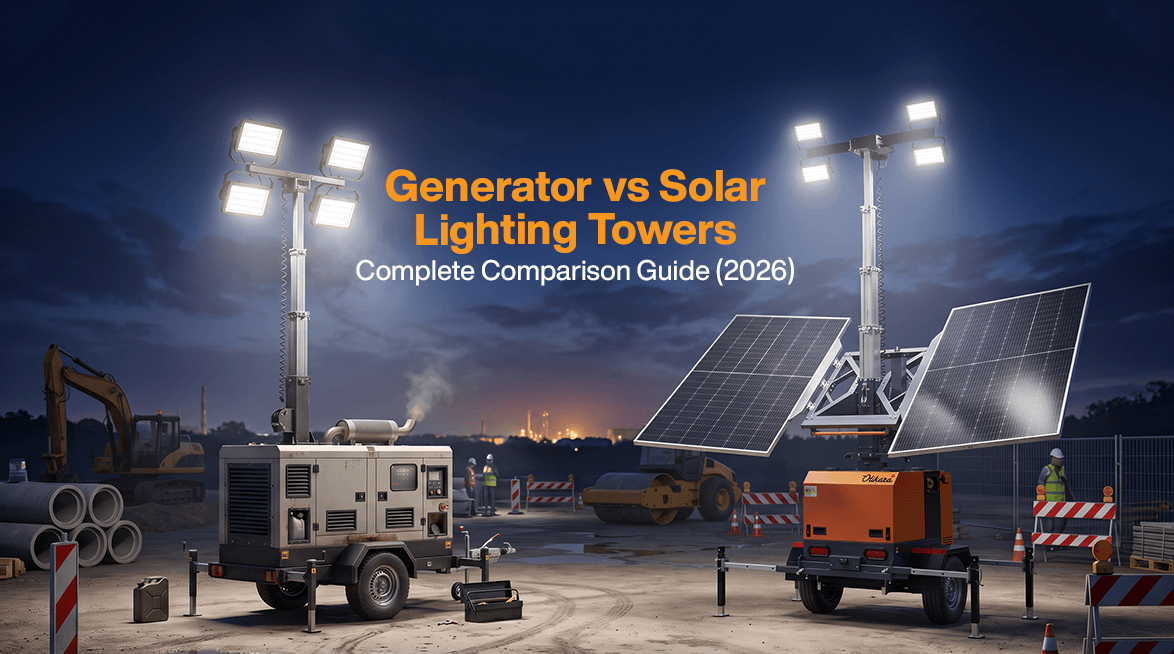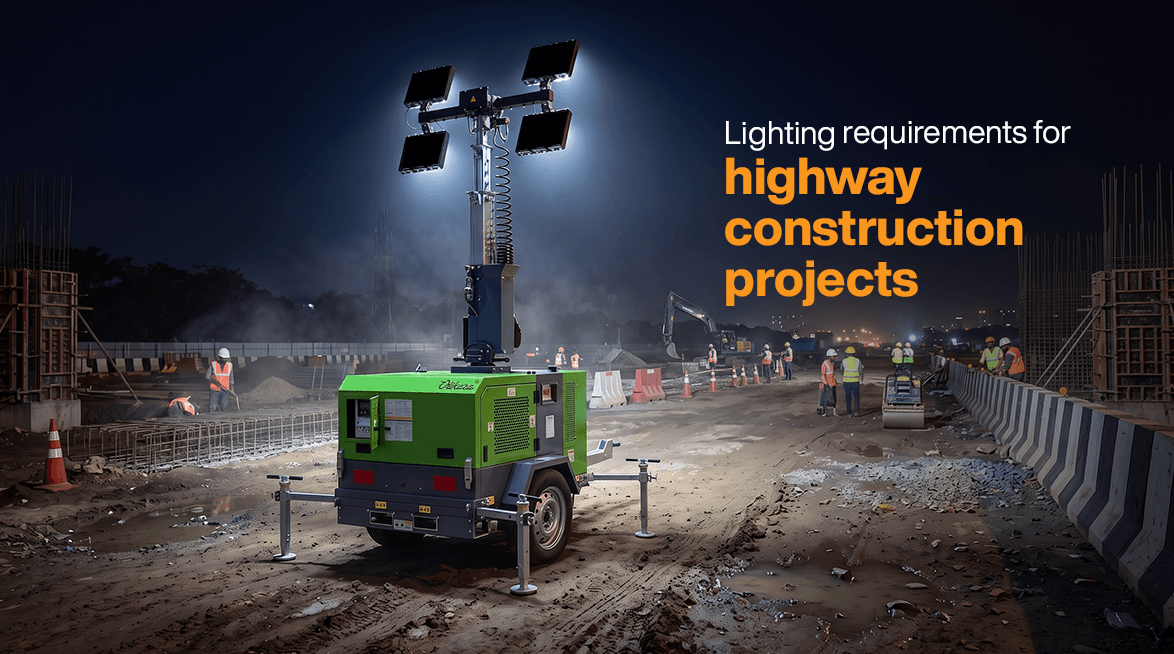
Construction on the highway doesn’t usually stop at night. Almost every construction task, such as night paving, bridge work, road widening, and even maintenance, requires dependable visibility without creating glare.
The right construction lighting towers provide illumination for active work areas, increase worker visibility, aid in equipment movement, and assist in maintaining project schedules. For highway projects, the goal is not simply to provide lighting; it’s to provide the proper light at the right place and at the right power level.
Let’s know more about lighting requirements for highway construction projects.
Why Highway Construction Needs Specialized Lighting
Highway work zones differ from typical construction sites because they involve active areas where workers, heavy equipment, construction vehicles, and pedestrians may operate in close proximity.
During nights when illumination levels are insufficient, uneven surfaces, barriers, machinery, excavation sites, temporary markings, and workers can become more difficult to see. Another concern is excessive or poorly positioned lighting, which can reduce visibility for approaching drivers.
This is becoming even more significant in India due to the scale of its highway development. The Ministry of Road Transport and Highways reported that the National Highways reach 5,852 km, This reflects the level of infrastructure activity, where temporary and mobile lighting can be a significant operational requirement.
The Federal Highway Administration (FHWA) makes a clear distinction between work-zone lighting and temporary roadway lighting. Work-zone lighting is designed to light activities that are being carried out at a construction site and temporary roadway lighting is designed to help road users navigate through temporary changes in the highway. In planning a highway lighting plan, this difference is significant.
Key Lighting Requirements for Highway Construction
1. Adequate Illumination for the Task
Different highway activities demand different levels of visibility. The general movement areas should be illuminated broadly, while precision activities like pavement working, crack filling, signalling or detailed finishing should be lit with greater task lighting.
FHWA guidance referencing NCHRP Report uses the following minimum illumination categories: 54 lux for general illumination, 108 lux for medium accuracy construction tasks, and 216 lux for high accuracy tasks.
It is important that project teams do not apply a single illuminance level to every worksite; instead, they should evaluate the specific task, work-zone geometry, equipment movement, and local needs.
2. Wide and Consistent Coverage
Construction sites on highways can be quite extensive. Light towers for construction sites should therefore provide useful illumination across the work area instead of creating isolated bright spots surrounded by dark zones.
The height and positioning of the mast are particularly important. Using a higher light source can cover a wider area, and setting multiple towers to provide light continuity can ensure that this illumination is maintained throughout the paving zone, material storage zone, access route, and equipment operating zone.
3. Glare Control
Brightness is not equivalent to good highway lighting. A tower positioned directly toward approaching traffic can create glare and reduce a driver’s ability to see workers, barriers, or changes in the roadway.
FHWA strongly suggests that work zone floodlights be strategically focused and not cast into a travel lane unnecessarily. Thus, lighting layouts should therefore be considered.
4. Reliable Power for the Project Environment
Highway projects are possible anywhere, from the densest urban environments to areas where there is no grid electric service. This makes choosing the right power source a crucial part of lighting selection.
| Lighting Type | Best for | Main Advantage | Key Consideration |
| Engine-powered | Remote or off-grid construction areas | Independent power supply | Requires fuel management |
| Grid-powered | Sites with dependable electrical access | Direct electrical operation | Requires suitable grid access |
| Hybrid | Projects seeking flexible and efficient operation | Combines rechargeable battery technology with solar capability | Requires appropriate charging conditions |
| Compact Engine-powered | Smaller work areas and localized activities | Portable and easy to deploy | Smaller illumination footprint |
Engine-powered options such as those offered by Olikara Lighting Towers feature engineered 1 to 6 kVA power, 3- to 7-metre mast height, and claimed runtimes from 6 to 70 hours for various engine configurations.
How to Choose the Right Towers for Construction Sites
1. Engine-Powered Towers
If an established electrical connection is not available, engine-powered lighting can give the independence that is necessary for night operations.
Olikara’s range includes Qube Power Mini, which is a smaller tower, and Qube Power, which is available for road and bridge construction. Qube Power Max is included among the larger solutions for highway infrastructure requirements.
Such an arrangement can be especially relevant in night paving, remote road widening, excavation, and any other circumstance where there is doubt about grid availability.
The key factor for contractors is ensuring that the tower’s output, mast height, runtime and mobility match the duration and physical size of the work zone.
2. Grid-Powered Towers
Not all highway projects are in remote areas. There may be access to reliable electrical infrastructure for urban highway upgrading, bridge approaches, urban roads, and infrastructure projects.
Under these circumstances, Olikara’s grid-powered towers are a feasible replacement for engine-powered towers. These include the available Qube Grid Base / Trailer and Qube Grid Max. They have LED lamps and extendable masts, and the grid-powered range is for applications such as construction and mining.
A grid-powered configuration can be particularly useful when tasks are focused where electric power is available.
3. Hybrid Towers
Projects that involve modifications to highways are becoming more complex and require a balance of reliability and energy efficiency. Hybrid lighting combines solar and battery power with a reliable backup source for continuous illumination.
Olikara’s hybrid-powered solutions include Qube Solar and Qube Power Max Hybrid. The solution range combines rechargeable batteries with solar technology, and the battery can be fully charged in 16 hours.
Hybrid technology can be a viable option for highway projects where reducing reliance on conventional power sources is an operational goal.
Lighting is as Important as the Equipment Itself
A technically competent tower will not be a good tower if it is not used properly. Before determining the number and location of towers, highway contractors should evaluate the whole work zone.
Key considerations include:
- Determine work areas, traffic lanes, equipment paths, excavation areas, etc. prior to the placement of towers.
- Install lights to minimise glare for oncoming traffic.
- Choose the mast size based on the desired coverage and site conditions.
- Before selecting a lighting tower, assess the project’s available power supply, operating requirements, and site conditions.
- Re-evaluate lighting when changing the work zone, traffic pattern, or construction activities.
In addition, FHWA’s recent nighttime work-zone initiative underscores the need for anti-glare lighting, as about half of all fatal work-zone crashes took place at night in 2023. It reinforces an important principle: treat lighting as an integral part of the overall work zone safety program, rather than as an add-on.
Conclusion
Highway construction lighting requires careful engineering, safety planning, and operational efficiency. The right system should provide appropriate light levels for the task, consistent coverage, effective glare control, reliable power, and flexibility as work areas change.
Olikara Lighting Towers offers engine-powered, grid-powered, and hybrid-powered lighting towers for construction and large infrastructure projects, including roads and highways. Careful selection of a configuration can contribute to the development of safer, more productive and controlled work environments during the night.
Illuminate your highway projects with reliable, efficient lighting solutions. Contact us today! |
FAQs
1. What type of lighting is best for a construction site?
Which tower is best depends on site conditions, required coverage, work time and power availability. Highway projects can use different types of lighting towers, including engine-powered, grid-powered, and hybrid models.
2. Why is glare control important in highway construction?
When lights are poorly directed, they can cause glare for oncoming drivers and impair the ability of drivers to see workers, barriers, and roadway changes.
3. Is it appropriate to use light towers for remote highway projects?
Yes. When grid electricity is not available, lighting towers can be useful, and hybrid solutions can work for projects that require flexible power.
4. How to select a lighting tower for a highway project?
Take into account the work-zone size, illumination needs, mast height, duration of operation, mobility, power source, and the nature of the construction activity.