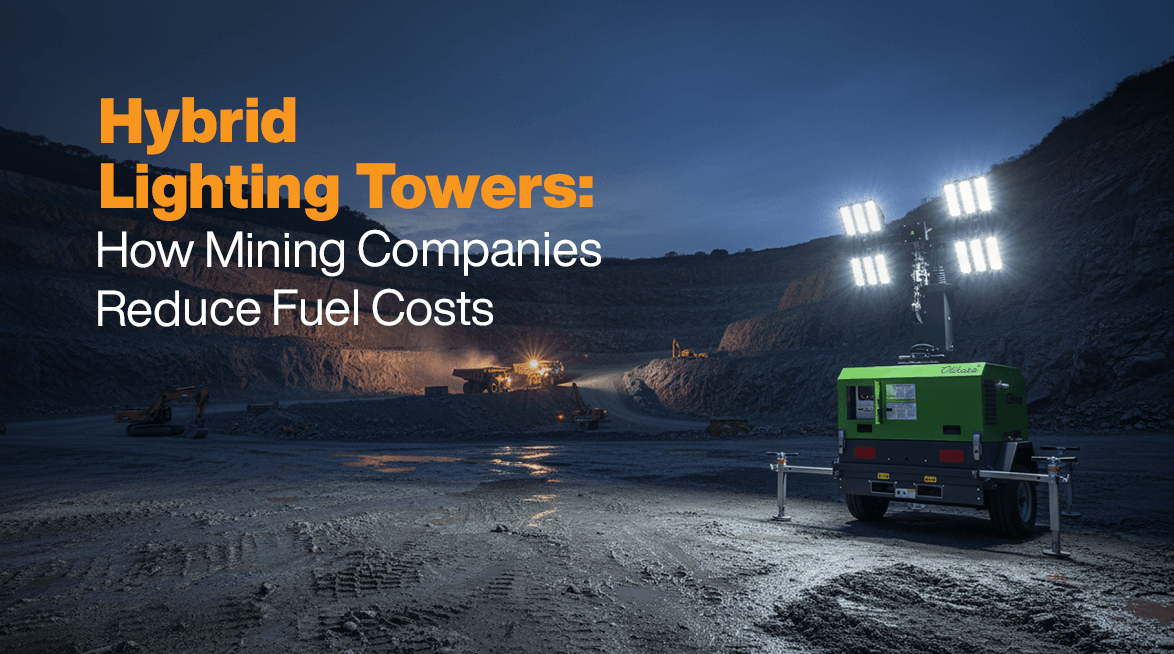
Mining sites operate at night and therefore require sufficient lighting to facilitate equipment repairs, excavation, and material handling. However, employing conventional diesel-based lighting equipment for long hours raises fuel consumption and operating costs.
Hybrid lighting towers offer a practical lighting solution by combining battery power with conventional power sources. This setup can reduce engine operating hours while ensuring a reliable supply of light for mining operations.
Choosing the right hybrid lighting towers can help mining operators reduce fuel consumption, improve energy efficiency, and maintain reliable illumination across mining sites. Understanding how these systems work can help operators assess their suitability for different mining applications.
Fuel Costs: A Key Concern for Mining Companies
Mining companies operate 24 hours a day, so they need continuous lighting for heavy machinery operations, loading, transportation, and repair work. Unless there is a good electric power supply available, companies need to use diesel-powered equipment for lighting tower operations.
However, continuous engine operation increases fuel consumption, servicing requirements, and equipment operating costs.
According to the International Energy Agency Coal 2025 report, fuel was needed for 40% of total mining expenses in Indonesia and 34% in Mozambique in 2025. This data indicates the importance of fuel usage in large-scale open-pit mining.
Although lighting towers are only one component of a mining operation’s energy needs, cutting down diesel fuel consumption can help in savings across the overall operation.
How Hybrid Lighting Towers Help Cut Down on Diesel Fuel Use?
Hybrid lighting towers involve the use of rechargeable battery systems and engine power or renewable energy technologies depending on the system’s design. This combination provides flexibility in power generation and reduces reliance on continuous engine operation. Rather than relying solely on engine use, the systems can instead use stored electric energy to power the lights.
When needed, battery recharging is done by the engine or any available charging device, based on the configuration of the system. In turn, such an approach provides savings opportunities.
1. Reduced Engine Operating Hours
In contrast to the diesel-powered towers that keep the engines running full time, hybrid lighting towers can function through accumulated energy.
So less engine working time means less diesel usage, fewer working hours of the engine, and longer time between needed maintenance visits.
For example, Olikara’s Qube Power Max Hybrid combines hybrid technology with a lighting solution designed for larger applications, including mining and oil-sector operations.
2. Better Usage of Alternative Energy Sources
The solar-powered hybrid lighting technology stores energy during the day for later use.
This means less dependence on diesel, especially when the lights are required after sunset. The actual savings depend on the solar energy availability, battery capacity, charging time, and the operating conditions of the devices.
Olikara’s Qube Solar is a solar light solution that uses solar energy and has built-in rechargeable batteries that can reportedly charge fully in 16 hours.
In areas where there is enough sunlight, this tower can greatly cut down the need for fuel-powered sources.
3. Lower Maintenance and Running Costs
Reducing engine operating hours can lower maintenance costs, which is particularly important for mining operations. Maintaining equipment at remote sites often involves additional expenses for transporting spare parts, arranging technical support, and bringing in specialised technicians.
Despite the fact that hybrid systems need to be checked and maintained, they require different operational procedures compared to diesel machinery.
Engine-Powered vs Hybrid vs Grid-Powered Lighting Towers
Power availability varies across mining sites, so selecting the right lighting tower depends on several site-specific factors.
| Comparison Factor | Engine-powered | Hybrid-powered | Grid-powered |
|---|---|---|---|
| Primary energy source | Diesel or petrol | Solar power and battery storage (where applicable) | External electricity supply |
| Fuel dependency | High | Reduced, depending on configuration | No onboard fuel storage required |
| Engine operation | Required | Depends on hybrid configuration and backup requirements | Not required |
| Best suited for | Remote mining locations | Sites seeking lower fuel dependence | Mines with reliable grid access |
| Operating considerations | Fuel and engine maintenance | Battery capacity and solar availability | Grid connectivity and electricity costs |
For instance, Qube Power Max represents an engine-powered option for demanding applications, while Qube Power Max Hybrid offers a hybrid alternative. Where an electrical connection is available, Qube Grid Max provides a grid-powered option.
Mining companies should assess site power availability, operating conditions, and fuel access to select lighting towers that meet their operational requirements.
What Should Mining Companies Consider Before Choosing Hybrid Lighting Towers?
Equipment selection should consider more than the initial purchase price; factors such as operating costs, maintenance requirements, and long-term performance are equally important.
The following factors deserve particular attention:
- Battery capacity: Check the battery capacity to ensure it can provide the required lighting duration without frequent recharging.
- Solar charging capacity: Assess sunlight availability to determine whether the charging system can meet the required operating hours.
- Lighting parameters: Review LED power, area to be illuminated, and the height of the tower based on the area of operations.
- Operational environment: Take dust, weather changes, and precipitation into consideration while selecting the equipment.
- Maintenance parameters: Evaluate battery and generator maintenance requirements, along with the availability of after-sales support.
Taking these measures will help mining companies to select equipment they actually need.
Conclusion
Hybrid lighting towers help mining companies reduce fuel consumption and maintain adequate illumination for safer and more efficient site operations. However, their actual performance depends on battery capacity, charging systems, lighting needs, and conditions of the site.
Reliable hybrid lighting tower manufacturers help mining companies select equipment based on their actual site requirements, operating conditions, and long-term costs rather than the initial investment alone. With its engine-powered, hybrid-powered, and grid-powered lighting solutions, Olikara Lighting Towers offers different power configurations to suit varied mining and industrial requirements.
Make your mining operations smarter.
Explore Olikara’s lighting solutions today!
FAQs
1. Is it practical to implement hybrid lighting towers in remote mining locations?
Yes, provided that the battery capacity, charging system, and lighting levels are appropriate for the intended remote area.
2. What are the key differences between hybrid lighting towers and engine lighting towers?
Engine-powered lighting towers use conventional fuel to generate electricity, while hybrid lighting towers combine battery storage with an engine-driven generator or other power sources.
3. What factors should mining companies consider before selecting a hybrid lighting tower supplier?
Mining companies should look into the available battery technologies, lighting performance, charging mechanisms, as well as the equipment’s durability and maintenance.

Other Blog