

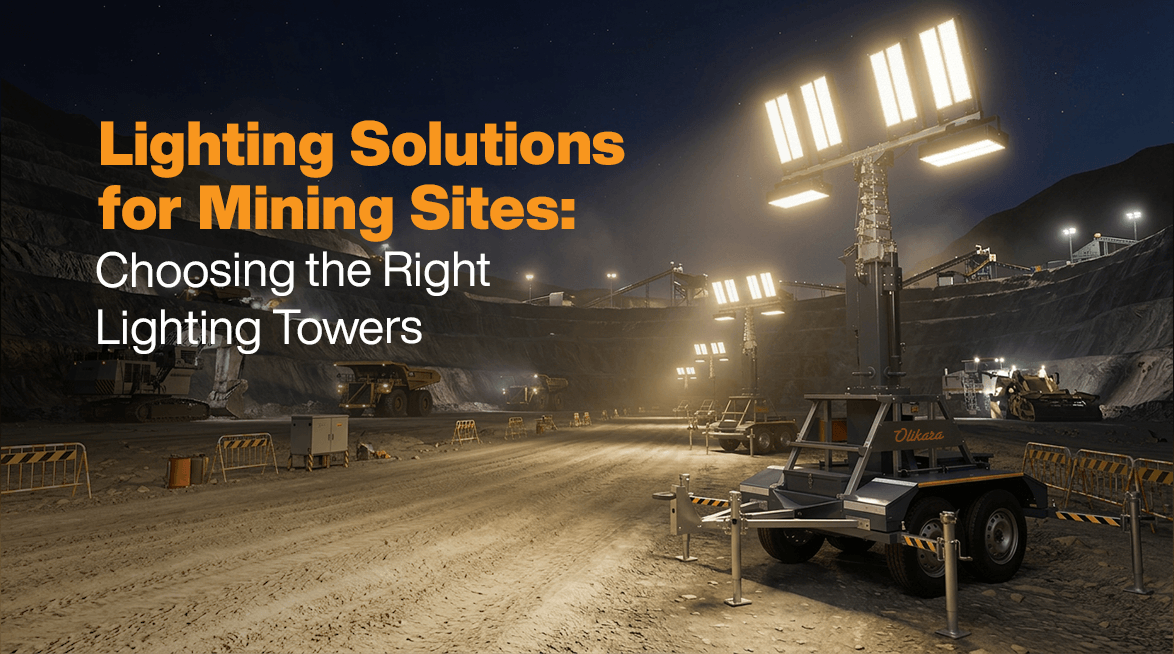
Proper visibility is a significant contributor to the successful operation of mines. Superior lighting guarantees efficiency and security on worksites regardless of the time of day.
The final selection of the towers is dependent on site conditions, power availability, the required level of illumination, and running costs.
Understanding different lighting towers helps mine operators achieve safe working conditions, improve visibility across work areas, and reduce unnecessary energy consumption, supporting smoother and more efficient mining operations. Let’s explore the key lighting towers.
The Need for Proper Equipment Lighting in Mining Operations
Visibility at mining sites often becomes limited during night shifts, making it difficult to carry out activities such as mineral extraction, material loading, and equipment maintenance safely and efficiently.
In India, almost 70% of fatalities are caused by coal mine accidents. This means that safety measures in the mining industry are important. These measures include proper lighting, equipment maintenance programs, checking ropes, chains, and lifting mechanisms, and identifying hazards.
Proper lighting leads to:
- Better visibility: This helps miners operate safely and avoid dangerous areas and equipment.
- Safe vehicle operations: Well-lit areas guarantee safe operations on haul roads, loading points, and places where machines are operating.
- Less time lost to downtime: Proper lighting allows mining operations to continue safely during night shifts, reducing work interruptions and delays.
- Improved inspections: The arrangement of proper lights facilitates visibility of equipment failures and hazards.
Types of Lighting Towers Suitable for Mining Sites
Different mining environments require different power configurations. The right lighting tower is selected by evaluating its illumination capacity, fuel efficiency, mobility, maintenance requirements, and suitability for specific mining conditions.
1. Engine-Powered Light Towers
In remote mining areas, there is often very little or no reliable electric power supply. Engine-powered lighting towers use diesel or petrol engines to generate electricity, providing an independent source of power for illuminating mining sites.
Such equipment is helpful for excavation sites, temporary haul roads, and other remote mining locations where there is no connection to a power supply. An example of this equipment is Olikara’s Qube Power, which can be used on mine haul roads.
These towers offer operational flexibility, but fuel consumption, engine maintenance, and noise levels must be considered.
2. Hybrid Lighting Towers
Companies in the mining sector are focusing more on the operational efficiency as well as energy efficiency of various equipment. Hybrid lighting towers are designed to use the traditional way of producing electricity with batteries.
Olikara’s Qube Power Max Hybrid is an example designed for larger applications, including mining environments. Hybrid lighting towers can be used when companies want alternative ways of providing energy for extended lighting requirements.
Fuel consumption depends on the tower’s daily operating duration, electrical load, lighting requirements, and site conditions.
3. Grid-Powered Lighting Towers
It is possible to implement grid-connected lighting towers in mining areas with a proper electricity supply system. If such systems are introduced, there is no need to use combustion engines.
For instance, Olikara’s Qube Grid Base / Trailer can serve small operations, while the Qube Grid Max is more appropriate for greater areas.
In particular, these systems are well suited to established mining sites with a stable and readily accessible electricity supply.
Comparison of Mining Lighting Tower Solutions
| Parameter | Engine-Powered | Hybrid-Powered | Grid-Powered |
|---|---|---|---|
| Primary power | Petrol or diesel | Engine and battery-supported system | External electrical supply |
| Ideal location | Remote mining sites | Extended operations seeking lower engine runtime | Electrified mining facilities |
| Fuel requirement | Regular | Potentially reduced | None during grid operation |
| Maintenance | Engine servicing | Engine and battery maintenance | Electrical system maintenance |
| Main limitation | Fuel and servicing costs | Higher system complexity | Dependence on grid availability |
Model examples and application categories are based on the manufacturer’s published lighting solutions range.
Key Factors to Consider When Choosing Mining Lighting Towers
1. Light Coverage and Mast Height
Lighting towers provide sufficient illumination across work areas while reducing glare and improving visibility for mining personnel.
As an illustration, Olikara’s Qube Power Max has an 8-meter mast, four LED fixtures, and a coverage area of 7,500 square meters. The Qube Grid Max features an 11-metre mast fitted with six 400 W fixtures, providing illumination across an area of up to 8,000 square metres.
However, to make sure everything functions properly, lighting has to be tested on the site rather than relying only on coverage figures.
2. Durability and Environmental Resistance
Lighting equipment used in mining has to be resistant to dust, vibration, changes in temperature, and uneven surfaces. Therefore, mining sites require durable fixtures, corrosion-resistant masts, and stable support structures.
3. Operating Costs and Maintenance
Mine operators should assess total ownership costs rather than purchase prices alone.
The important points to consider are:
- How much fuel and electricity are consumed?
- What maintenance is required (engine service, battery upkeep, and electrical checks)?
- Are the towers easy to install?
- How reliable is it (availability of power, operating hours, etc.)?
When it comes to evaluating all factors, the experience of lighting tower suppliers can help assess project-specific requirements and recommend suitable solutions.
Conclusion
When selecting the right mining lighting towers, you must consider visibility, reliability, and energy efficiency. Engine-powered technologies can be used at remote sites, while hybrid towers provide alternative modes of operation, and grid-connected towers can be utilized in areas with stable energy supply.
Olikara Lighting Towers offers electric-powered, hybrid, and grid-powered lighting solutions to meet the diverse requirements of mining operations. Selecting the right configuration helps reduce operating costs, improve energy efficiency, and ensure reliable illumination across mining sites.
Keep your mining operations running safely, even after sunset.
Explore Olikara’s lighting towers now!
FAQs
1. Which type of lighting tower can be installed at remote mining operations?
Engine-powered lighting towers are usually good for remote mining operations that do not have a reliable electricity supply.
2. Is a hybrid lighting tower good for mining operations?
Yes, a hybrid lighting tower combines engine and battery power, allowing it to operate using different energy sources depending on site requirements.
3. What determines the functioning of lighting towers in the mines?
Lighting tower performance in mines depends on mast height, LED output, illumination distribution, site conditions, weather, and the reliability of the power supply.
4. In what way does being grid-powered help lighting towers in mining facilities?
Being grid-powered means that working lights do not need engine operation on site if reliable electricity is available.


