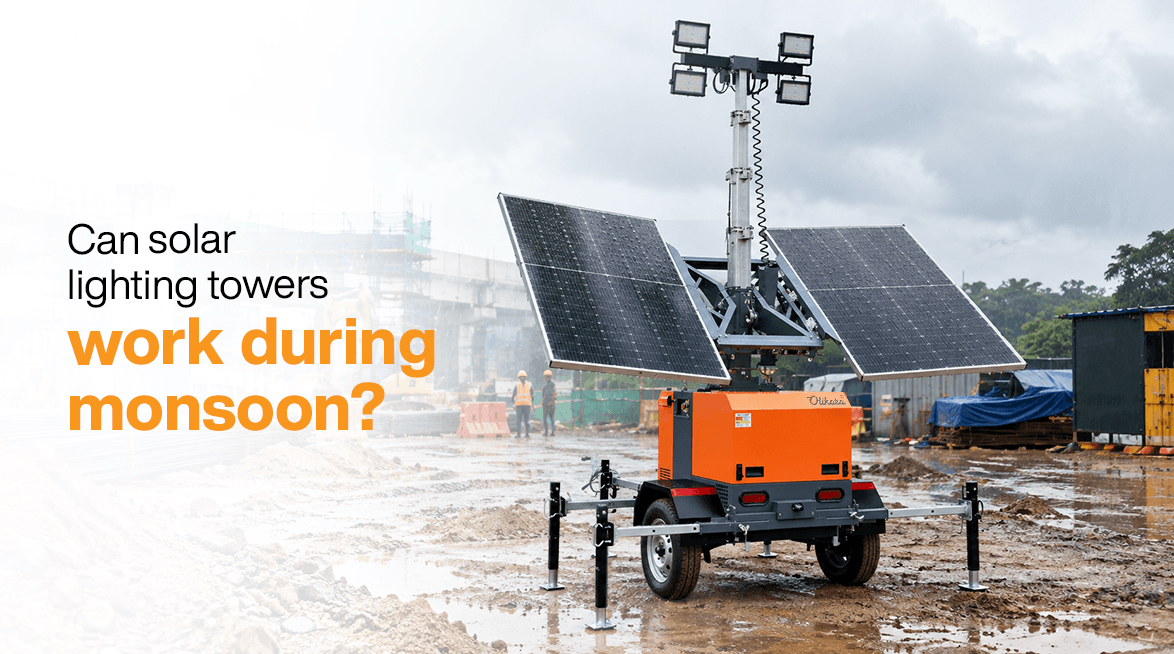
Yes, solar lighting towers can work during the monsoon, although their performance depends on solar availability, battery capacity, and the system’s suitability for outdoor conditions.
Rain does not prevent a solar tower from working, but monsoon conditions in India can significantly affect solar availability. The primary challenge is that when it’s cloudy for extended periods, solar power is less available. Therefore, a reliable solar lighting system should incorporate adequate energy storage, efficient lighting, and a design suited to fluctuating weather conditions.
Let’s explore more and know how solar lighting towers perform during the monsoon and what factors influence their reliability.
How Do Solar Lighting Towers Work During Rain?
A solar lighting tower does not require sunlight during the night. Photovoltaic panels generate electricity during daylight hours, which is stored in an integrated battery. When the sun sets, the lights turn on with the stored energy.
Solar availability can significantly affect the monsoon conditions of India. As per the reports, the southwest monsoon rainfall for 2024 amounted to 108% of LPA which makes it essential to set up outdoor equipment that can withstand the fluctuations in the weather.
The most important consideration is energy balance, that is, the electricity that is generated by the panels must be equal to the electricity that is consumed by the lighting system.
When the solar conditions are favorable, the tower can produce sufficient power during daylight hours and store a sufficient reserve that will allow it to operate even during adverse weather conditions like cloudiness or rainfall. But if solar generation remains low for several consecutive days , this can add to the pressure on the battery reserve.
Why Battery Capacity is Important in Monsoon
Battery storage bridges the gap between daytime solar generation and nighttime energy consumption.
During periods of adequate sunlight, excess solar energy can be stored in a tower of an appropriate size and battery that can later be retrieved when solar production is reduced. This makes battery capacity one of the most significant components to consider when choosing a solar tower to use during the monsoon season.
For instance, Olikara’s Qube Solar features two 550 W monocrystalline bifacial solar panels, delivering an input of 1100 W from the solar source, and a 10.8 kVAh battery pack. It features four 100 W LED lights that provide approximately 10-15 hours of runtime under specified operating conditions.
Why is a Solar Lighting Tower Appropriate for Monsoon?
When selecting a lighting tower for monsoon operation, the buyer should consider the entire energy and mechanical system, not just the solar panel wattage.
Important considerations include:
- Battery capacity: Higher battery capacity provides higher energy reserves during periods of insufficient sunlight.
- Correct location of PV panels: Optimal panel location and configuration of solar panels can maximize energy generation potential.
- LED efficiency: High-efficiency LEDs consume less utilize less stored energy when operating.
- Lighting controls: Dimming can be used to reduce energy costs to match lighting needs.
- Outdoor construction: The mast, chassis, electricals and stabilisation system should be appropriate for outdoor operating conditions.
- Site stability: Wet ground conditions make proper positioning and stabilisation particularly important.
For example, Olikara’s hybrid towers feature adjustable solar-panel orientation and dimmable LED lights, which enable a more efficient utilization of the available solar resources.
Solar vs Engine, Hybrid and Grid-Powered Lighting Towers
While the purposes of the two systems are alike in their on-site application, solar lighting towers depend on battery-powered operation and include solar power as a backup, whereas hybrid towers also use an engine as a backup for greater reliability.
The appropriate technology will vary according to the lighting requirements, site conditions, hours of use and power availability of the project. So, let’s compare the three.
| Feature | Solar/Hybrid | Engine | Grid |
| Main energy source | Solar + battery (with engine backup in hybrid) | Diesel engine | Grid electricity |
| Dependence on sunlight | Moderate (reduced in hybrid due to backup engine) | Low | None |
| Fuel requirement | No (solar mode) / Yes (hybrid backup only) | Yes | No |
| Suitability for Remote Sites | Very high | Very high | Depends on grid availability |
| Noise | Very low (solar mode) / higher when engine runs | Higher | Very low |
| Ideal applications | Remote sites, infrastructure, and critical backup lighting | Long-duration demanding sites | Connected sites and facilities |
This comparison illustrates why it is important to consider the power source based on the requirements of the project, not just because the tower is solar-powered.
How Can You Improve Solar Tower Performance During Monsoon?
- Place the solar panels in a suitable location to maximize daylight.
- Keeping panels reasonably clean and free from dirt and debris compounds the loss of generation.
- Full lighting is not always necessary; it is advisable to use dimming.
- Select battery capacity based on the required operating duration and expected solar availability.
- Make sure the tower is properly stabilized, particularly in the case of rain influencing ground conditions.
- Choose between solar, engine, or hybrid and grid power based on the actual requirements for reliability at the site.
What Questions to Ask Solar Light Tower Suppliers?
Do not evaluate the solar-light-tower supplier based solely on the solar-panel capacity of their product. Evaluate battery storage, expected runtime, LED load, lighting coverage, panel configuration, mobility, mast construction, and applications.
The same principle applies when comparing lighting tower manufacturers and lighting tower suppliers. The ideal tower suited for one site may not be the best tower for another.
Final Conclusion:
- In certain projects, it is essential that lighting is available at all times, even in cloudy weather, and for this type of project an engine-powered system may be a more reliable source of power.
- A hybrid system is another option for projects that require battery-based operation with conventional engine backup.
- Grid-powered lighting towers do not have to rely on solar generation or fuel when a reliable electricity connection is available.
Conclusion
So, is it possible to operate solar lighting towers during the monsoon? Absolutely. Rain does not prevent solar lighting towers from operating, although prolonged cloud cover can reduce solar energy generation. The more severe problem is decreased sunlight, especially if it’s cloudy for two or more days in a row.
This is where a solar lighting tower solves the problem, with the right battery storage, efficient LED lighting, strong outdoor design, and adequate solar panel capacity. However, solar-powered systems may not be suitable for every application. For sites where weather, operating hours or site conditions require it, an engine-powered, hybrid and grid-powered system can offer flexibility.
When choosing trusted solar light tower suppliers, the most important thing to do is to evaluate the full power architecture according to the project site, lighting coverage, running time and monsoon situation. Here, Olikara Lighting Towers come into play. At Olikara Lighting Towers, we provide a variety of lighting solutions, including solar, engine-powered, hybrid and grid-powered for different site needs for demanding outdoor applications.
Looking for reliable lighting solutions for your monsoon projects? Contact now! |
FAQs
1. Do solar lighting towers charge during the rainy season?
Yes. Although solar panels generate less electricity under cloudy skies, they will still produce some electricity. When solar generation is temporarily reduced, the battery storage system helps to keep lights on.
2. How long can a solar lighting tower run during monsoon?
Runtime depends on battery capacity, solar generation, LED load and operating conditions. Olikara’s towers provide about 10-15 hours of run time under specified operating conditions.
3. During extended monsoon periods, would a hybrid lighting tower be more effective?
A hybrid system may be beneficial to ensure that lighting is always available when it is needed, as battery storage can be provided when solar is not.
4. What should I check before buying a monsoon-ready lighting tower?
Compare the battery capacity, battery runtime, LED load, lighting coverage, solar configuration, construction, stabilisation and the suitability of solar, engine, hybrid or grid power.

Other Blog