From construction sites and mines to industrial facilities and outdoor events, choosing between generator-powered and solar light towers significantly impacts project efficiency, sustainability, and operational expenses.
Modern solar light towers are no longer limited to eco-friendly projects; they’ve become viable solutions for mainstream industrial projects. Also, generator-powered towers are still used for demanding, high-power applications. Understanding where each technology performs best helps maximize output and minimize costs over the long term.
As industries transition toward cleaner energy without compromising performance, selecting the right lighting solution has become more strategic than ever. Let’s compare both these towers.
Why Solar Light Towers are Growing Rapidly
As the world moves toward renewable energy, solar-powered equipment has become a popular choice for construction and infrastructure projects.
In fact, solar PV electricity generation grew by nearly 30% in 2024, accounting for nearly 2,000 TWh globally, making solar the fastest-growing source of renewable electricity generation worldwide. This fast growth is a result of more investments in sustainable infrastructure and energy-efficient job sites. This has increased demand for solar light towers, particularly across construction and infrastructure projects aiming to reduce fuel costs and carbon emissions, particularly in the construction industry, because of the need to cut costs and carbon emissions.
Generator vs Solar Light Towers: Quick Comparison
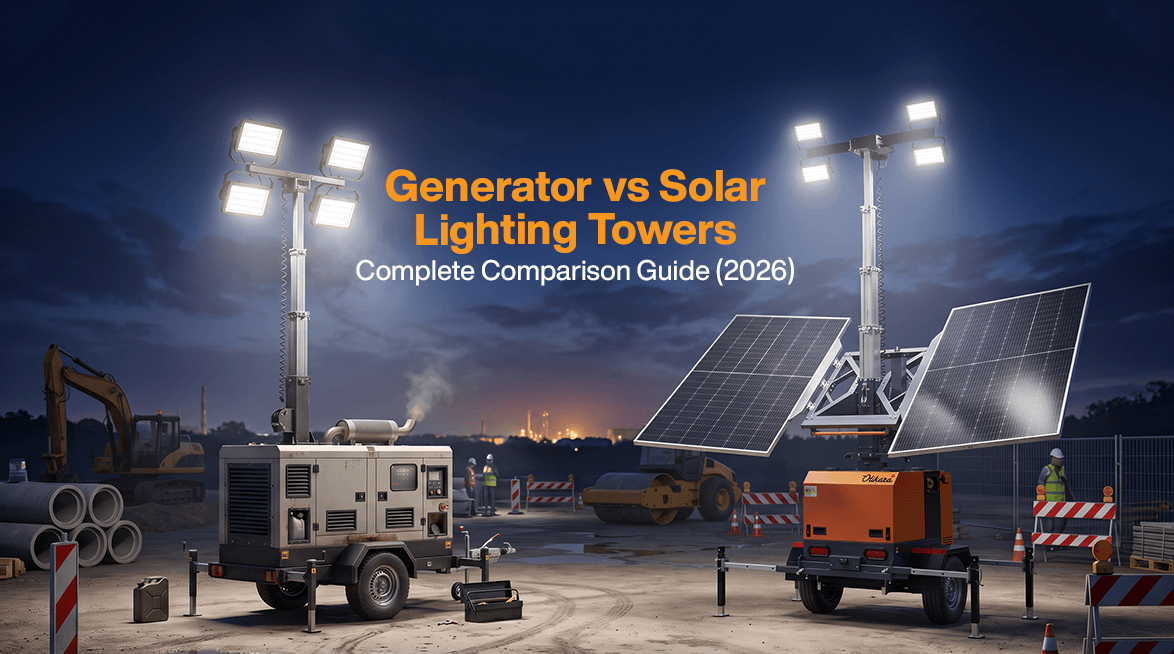
| Feature | Generator Light Towers | Solar Light Towers |
|---|---|---|
| Power Source | Diesel/Petrol generator | Solar panels and battery |
| Fuel Costs | High | Nearly zero |
| Operating Noise | Moderate to high | Silent |
| Maintenance | Regular engine maintenance | Minimal |
| Emissions | Carbon emissions | Almost zero emissions |
| Runtime | Long, with refueling | Depends on the capacity of the battery |
| Weather Dependency | No | Yes, partially |
| Remote Locations | Excellent | Excellent (with full sunlight) |
| Long-term Operating Costs | High | Low |
| Sustainability | Moderate | Excellent |
Generator Light Towers: When are they the Better Choice?
For projects that need continuous lighting in harsh environments, generator-powered lighting towers are still the preferred choice.
The operations of large mines, infrastructure projects, highways, oil and gas projects, and emergency response teams demand continuous lighting regardless of weather conditions for multiple shifts.
For instance, Olikara’s generator-powered lighting tower range is well suited for a wide range of emergency applications. Their Qube Power Mini is ideal for smaller applications, like emergency use, plant maintenance, and boundary walls. Qube Power can be used for medium-scale infrastructure projects, parking lots, factories, commercial projects, railway yards, etc.
Qube Power Max is designed for demanding mining operations, highways, dams, bridges, military applications and oil exploration that require extended operating hours. . The range of these models comes with either diesel or petrol power and provides runtimes of around 6-70 hours, depending on the model.
Generator-powered towers also perform consistently in cloudy conditions and provide dependable illumination without depending on battery charging cycles.
Solar Light Towers: When They Deliver Maximum Value
Modern solar lighting systems have evolved far beyond temporary lighting solutions. Modern systems integrate high-efficiency LED fixtures, advanced battery storage, intelligent charging controllers, and durable solar panels to deliver dependable illumination while significantly reducing operating expenses.
Solar is becoming the preferred choice of industries because of the following benefits:
- Zero fuel consumption during operation
- Silent performance for residential or urban projects
- Reduced maintenance expenses because of reduced moving parts
- Lower carbon footprint for ESG and sustainability goals
- Long-term ROI improvement
- Environmental compliance on green construction sites
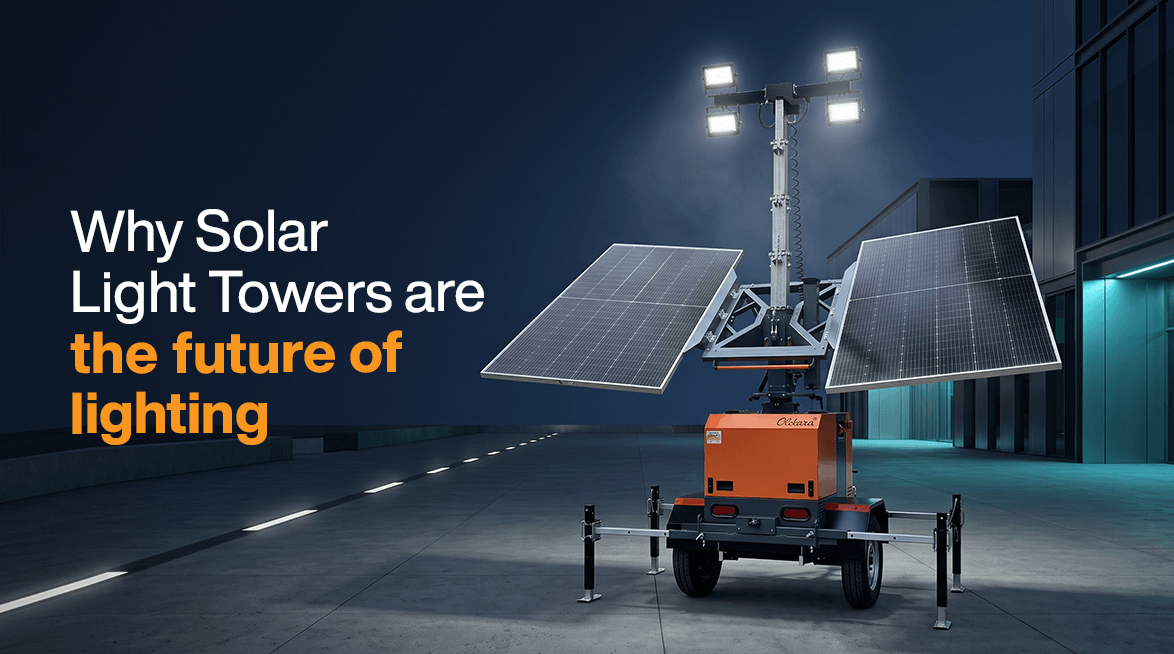
For example, Olikara’s Qube Solar is a medium-scale solution that integrates solar charging and battery storage to power medium-scale construction projects, railway yards, city works and infrastructure.
If high flexibility is needed for larger operations, Qube Power Max Hybrid combines renewable energy with engine backup to enhance uptime and minimize fuel usage.
Which Option Costs Less Over Time?
The initial cost of generator-powered towers is lower, but there are ongoing costs associated with fuel, servicing, engine maintenance, oil changes, and transportation.
Although solar lighting systems typically cost more in the initial setup, they have significantly reduced operating costs because they operate using solar-generated energy and require no daily fuel consumption.
Many contractors have found that over a period of 5-10 years of continuous operation, the costs of solar systems are more cost-effective, especially for long-duration projects and a fairly consistent amount of daylight.
But the decision should always be based on project requirements and not on purchase price.
Choosing the Right Tower for Different Applications
Each project is different and it’s important to select the power source that fits the lighting needs for each specific project.
In areas where access to fuel is challenging, such as remote construction sites, hybrid systems combine renewable charging with reliable engine backup, which is often making them ideal for remote infrastructure projects. The long battery life and brightness of hybrid lighting towers make them an excellent option for infrastructure contractors on highway and bridge construction projects.
When municipalities are organizing public events or maintenance activities near residential areas, they are often interested in quieter alternatives, where low noise levels are a priority. Grid-powered lighting towers are also designed for large applications where it is possible to maintain stable grid access.
Generator, Grid, or Solar: Which One Should You Choose?
Rather than asking which technology is universally better, evaluate the operating conditions of your project.
For situations that require continuous operation, durability in all weather conditions and demanding industrial use, engine-powered lighting towers still offer great value for money.
Where optimizing fuel usage, sustainability, quiet performance, and lifecycle cost are more important, solar-powered solutions offer the greatest value.
If both are required at the same time, hybrid technology can be an effective middle-ground solution to balance renewable energy and reliable backup power.
For many projects these days, more than one type of lighting tower is used, depending on what the project requires.
Conclusion
Comparing generator and solar lighting towers is not a battle of traditional vs modern technology. Rather, it’s choosing the best answer for the right application.
Whether for intensive industrial use or lowering operating costs, reducing emissions and achieving sustainability goals, engine-powered towers remain unmatched in reliability, whereas solar and hybrid systems offer greater operational flexibility for organizations seeking greater sustainability.
Olikara Lighting Towers is one of the trusted solar light tower suppliers and provides a complete range of engine-powered, grid-powered, hybrid and solar-powered light towers for construction, mining, and large-scale events.
Choose the right lighting solution to improve safety, productivity, and operational efficiency across your project.
Contact our team to find the right lighting tower for your application.
FAQs
1. Can solar light towers be used on construction sites?
Yes. With a wide range of modern solar lights available, solar lighting has become a practical solution for construction sites, while also being much more cost-effective and eco-friendly, especially in long-duration projects.
2. Which is more economical: a generator or solar light towers?
The cost of the generator tower is typically lower, while the solar light tower has lower operating and maintenance costs.
3. Is it possible to replace diesel light towers with hybrid light towers?
For many applications, hybrid light towers can be used instead of diesel units and can provide reliable backup power when fuel savings and sustainability are important.
4. What is the difference between generator-powered, grid-powered, and solar light towers?
The selection depends on the length of the project, the power source, the environment, the operating budget and the desired runtime. The best long-term value comes from selecting the lighting tower that matches your application’s operating requirements.