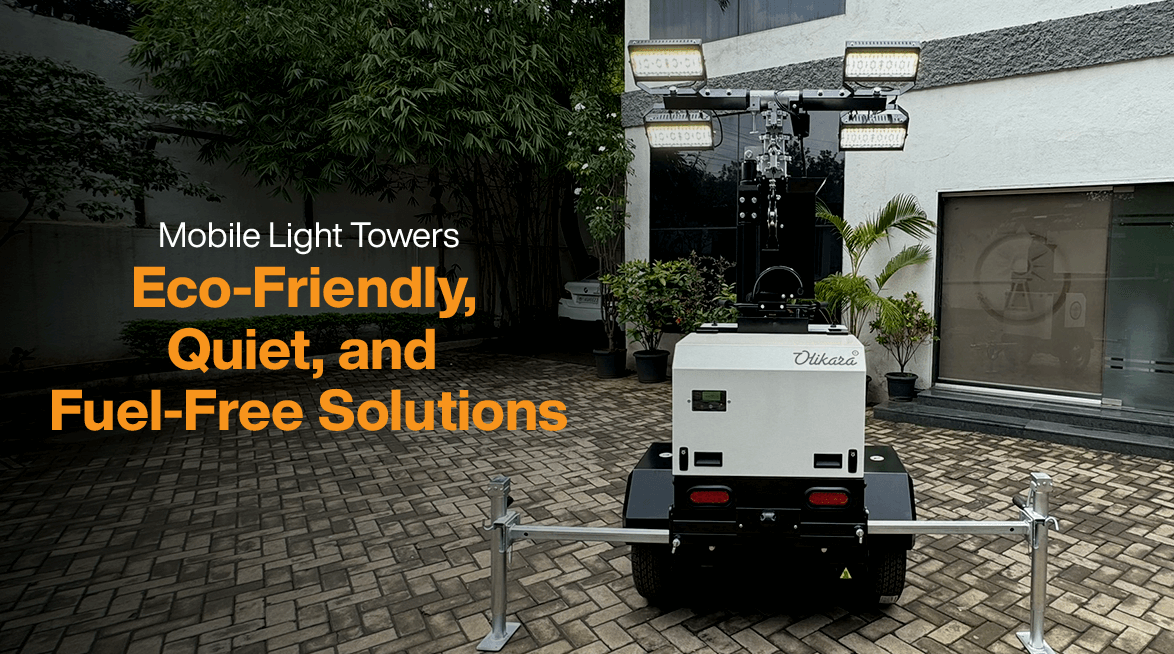
The importance of lighting in industries, especially the ones that are active during the night time, such as construction sites, infrastructure, and mines, emergency relief operations, and outdoor events, is immense. Historically, light towers that have been traditionally powered by diesel constituted the preferred choice of providing temporary lighting. But increasing environmental consciousness and the cost-effectiveness of operations have accelerated the the transition to Solar Light Towers.
Solar-powered light towers are a combination of renewable energy and advanced technology in lighting to ensure efficient illumination without the use of fuel and high noise levels. With sustainability being a core component of the industrial processes, manufacturers of solar light towers are on the move to develop efficient models that minimize the emission of carbon as well as enhance the performance of the lights.
Let’s deep dive into the world of solar-powered light towers and understand how they work.
The Rising Demand for Solar Lighting Towers
Organizations working in different industries are trying to find lighting solutions that reduce the costs of operation and environmental impact. The solar-powered lighting towers are very efficient and sustainable and can be moved easily (portable).
The International Energy Agency (IEA) also reported that the worldwide solar power generation increased by over 320 TWh in 2024, the highest rate of growth in the generation of renewable energy per year.
This fast growth is an indication that solar technologies are becoming a mainstream activity in industries, even as a temporary source of lighting.
In instances where businesses have large project locations, conversion to Solar Light Towers significantly reduces the fuel dependency and would also contribute to the attainment of sustainability goals.
Key Components of a Solar-Powered Light Tower
To find out how a solar-powered light tower functions, one should begin with the analysis of the key components of this tower. All the components have a certain position in transforming the sunlight into a strong night light.
1. Solar Panels
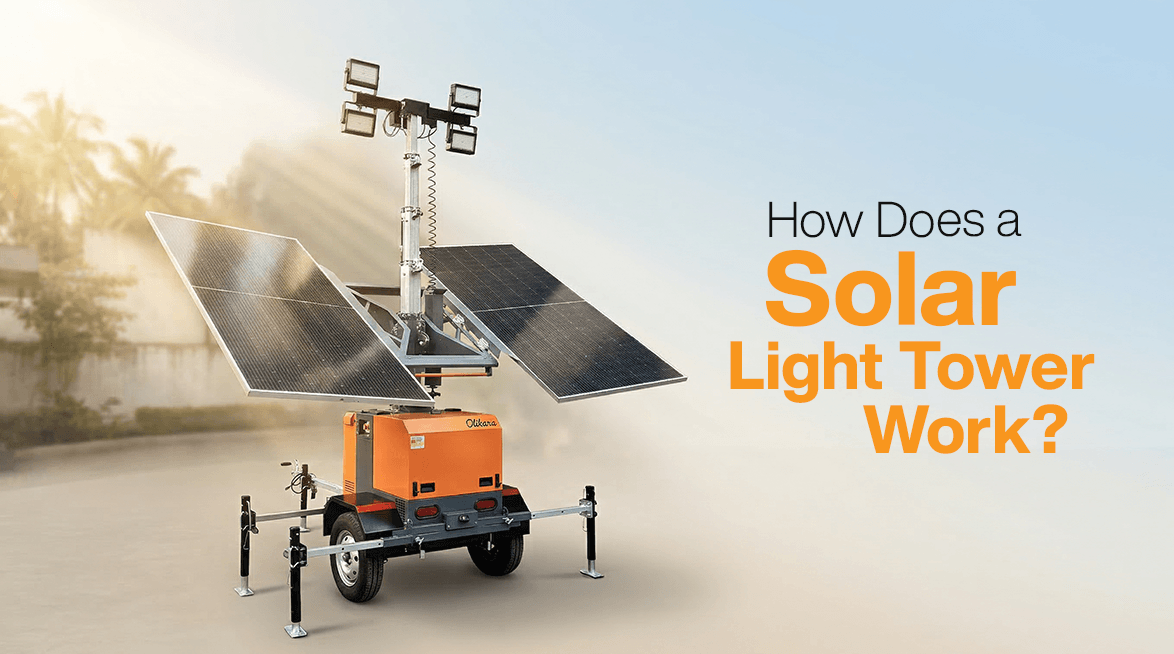
The lighting tower largely relies on solar panels as the primary power source. Photovoltaic (PV) technology absorbs the sunlight with such panels and transforms the energy into electricity.
The efficiency of the tower depends on the efficiency of the solar panels. The manufacturers of the modern Solar Light Tower use high-efficiency photovoltaic panels that recover maximum energy even in partially cloudy weather.
An example is a well-designed solar lighting system provided by Olikara with adjustable panel mounts that enable the operator to adjust the panel angle so that the system can capture the maximum amount of sunlight. This is to guarantee maximum energy production during the day.
The solar panels are normally attached to the top part of the tower frame; hence, they are easily adjusted and avoid the obstacles on the site.
2. Battery Storage System
Solar towers must be fitted with a battery storage system because lighting is mostly required at night and they must store energy gained through the day.
The electricity is stored in batteries on the solar panels using high-capacity lithium-ion batteries or deep-cycle batteries. These batteries are able to provide a continuous energy supply to light up the lighting fixtures after the sun goes down.
Having a good quality battery system guarantees:
- Long operating hours
- Stable voltage output
- Low-maintenance needs
In high-end solar lighting systems, battery storage is maximized to allow the tower to operate through several nights, even when sunlight is limited.
Olikara, one of the reputed Solar Light Tower manufacturers, is designing battery compartments that have more thermal management and safety enhancements to increase the lifespan and performance in extreme environments.
3. LED Lighting System
The lighting technology that is typically used in solar towers is the LED-based technology, as this technology uses less energy and produces a high level of intensity.
The LED floodlights consume less energy than the traditional halogen or metal-halide lamps and are brighter. This makes them perfect for solar-powered systems in which energy efficiency is critical.
A high-performance lighting tower has several LED lamps attached to a telescopic mast. These lights are adaptable and can be used to light large spaces, including:
- Construction zones
- Industrial yards
- Roadwork sites
- Outdoor events
A system with proper design can light up big spaces without consuming a lot of energy.
4. Telescopic Mast Structure
The vertical structure that elevates the lighting fixtures is known as the mast. It aims at expanding the area of coverage and spreading the light uniformly over the worksite.
The telescopic masts enable the operators to lift or lower the lights as needed to cover the required area of illumination.
Common characteristics of modern mast designs are:
- Either manual or hydraulic lifting systems
- High wind resistance
- Sturdy galvanized steel construction
Indicatively, some solar lighting tower systems are designed to have telescopic masts with multi-sections which stretch to great heights to enable broad coverage within an industrial location.
5. Smart Controller System
The main component is the controller, which controls power system flow between solar panels, the battery system, and the LED lights.
It is an intelligent system that makes sure that the energy stored is used effectively. It controls the charging of the batteries throughout the day and lights up the system automatically when it is dark.
High-end controllers have such functions as:
- Automatic dusk-to-dawn control
- Battery safety measures
- Remote monitoring facilities
These smart systems enhance the efficiency and reliability of solar lighting towers and are therefore applicable in remote places where manual supervision is restricted.
How the Solar Light Tower Works: Step-by-Step
With the components in mind, now we are going to look at how a solar-powered light tower works.
Step 1: Solar Energy Collection
The solar panels are photovoltaic and absorb the sunshine throughout the day converting the sunlight into electrical energy using photovoltaic cells.
These panels are designed in such a manner to enable maximum energy uptake even on sunny days at different times so that the solar light system could generate enough power to supply the night light system.
For example, Olikara’s Qube Power Max Hybrid comes with a battery pack of 7.2 kVAH, providing a runtime of 2 to 3 hours.
Step 2: Energy Storage
The solar panels produce electricity that is passed through the battery storage system.
These large-capacity, batteries are used to store the collected energy during the day so that it can be utilized later when the LED lighting system is running at night.
Step 3: Intelligent Energy Control
The charging between the solar panels and batteries is controlled by an intelligent controller. It eliminates the chances of excessive charging and also guarantees efficient energy management.
This conserves the battery life and at the same time utilizes the stored power to guarantee reliable lighting performance when the lights are in use over extended durations at nighttime.
Step 4: Auto Light Activation
Once the daylight starts to diminish, the controller will switch the LED lighting system on.
This dusk-dawn-type operation eliminates the process of manual switching and keeps the worksite or area illuminated continuously throughout the night.
Step 5: Effective Night Lighting
The battery power is stored and used to power the high-efficiency LED lamps in the telescopic mast. Qube Solar, a hybrid light tower offered by Olikara, has a mast height of 7m. Due to this stability and height, there is no compromise to power illumination, even at night.
These lights offer extensive illumination whilst using less power, which means the solar light tower can give bright and continuous illumination for a few hours without energy wastage.
Applications of Solar Lighting Towers
The application of solar lighting towers has become common in a broad spectrum of sectors.
- Construction Sites: Construction projects should have good night lights. The solar towers have round-the-clock illumination that does not need fuel logistics.
- Infrastructure Projects: Construction of roadworks, bridges, and maintenance of railways are common during the night, and therefore, the solar lighting towers are very useful.
- Mining Operations: Solar towers are advantageous in remote mining sites because they do not need to rely on fuel chains.
- Disaster Relief and Emergency: The solar towers offer instantaneous lighting within disaster areas that lack an electricity infrastructure.
- Outdoor Events: Solar lighting towers are becoming the favorite of festivals, exhibitions, and sports events because they are silent and sustainable.
Conclusion
A strong example of sustainability, technology, and industrial functionality is the solar-powered lighting towers. These towers offer high-quality lighting without much expense and environmental impact (especially the diesel-powered ones), as they convert sunlight into stored electrical power and employ effective LED lamps to offer consistent illumination.
Whether it is construction sites and mining operations, emergency response and outdoor events, Solar Light Towers are becoming a very important solution for modern industries to find efficient and environmentally adept lighting.
With the need for sustainable infrastructure development, solar light tower suppliers such as Olikara Lighting Towers have been playing a role in this change by coming up with sophisticated solar-powered light products. Our solar lighting towers are sustainable in nature, efficient, and usable over the long period.
To know more about How Solar Light Towers Work, Contact Olikara now! |
FAQs
1. What are Solar Light Tower Applications?
The Solar Light Towers are used to provide temporary light services to construction sites, infrastructure projects, mining projects and outdoor events.
2. How long can a solar light tower operate at night?
Most of the solar lighting towers can run 8-12 hours on a full charge, depending on the size of the battery and the power consumption of the LEDs.
3. Is solar light better than a diesel light tower?
Solar light towers are also clean and silent, and cheaper since they do not use fuel and do not require a lot of maintenance.
4. How to choose the reliable manufacturers of Solar Light Tower?
Seek manufacturers like Olikara providing solutions with high-efficiency solar panels, stable mast structures, robust battery systems, and a history of experience in the industry.