Improve Site Efficiency with Solar Light Towers
Nowadays, construction projects work under a lot of pressure: tight deadlines, rising fuel prices, and stringent environmental regulations. Lighting, in that aspect, ceases to be just a mere feature; it is one of the primary driving forces of operations. Lighting systems are important in ensuring that you can extend working hours, ensure the safety of workers, and maintain productivity even after the sun sets.
This is where the portable solar light towers are revolutionizing the industry. They offer a more efficient and effective alternative to the traditional diesel-powered systems. However, simply adopting solar towers is not enough. Real efficiency is in the way they are strategically deployed, managed, as well as integrated into your workflow. Let’s see how you can improve the efficiency well.
Understanding What Efficiency Actually Means on Your Site
Construction lighting efficiency is much more than being bright. It is about getting the most out of the least input, be it the fuel, time, effort, or maintenance. Portable solar light towers bring a multi-dimensional efficiency advantage. They do not depend on fuel supply chains, their operating costs are significantly lower, and they do not need a lot of mechanical parts.
More to the point, they can be useful in continuous working processes, particularly in remote or off-grid areas in which traditional lighting can be a logistical nightmare. For example, in infrastructure projects where fuel logistics are complicated, solar-powered towers can save up to 30 percent of operating costs.
It is not merely a cost-benefit; it is a strategic benefit.
How Smart Placement of Towers Maximizes Efficiency
Among the most widespread mistakes on construction sites is relying on the use of lighting equipment rather than focusing on optimal placement.
What smart placement looks like:
- Position towers on high grounds to increase coverage
- Pay emphasis to high-activity areas such as loading areas and excavation sites
- To minimize the wastage of energy, light beams should not overlap each other
Why it matters: Two badly placed towers can be substituted by a well-placed tower. As an example, in the case of large-scale road construction, hybrid systems such as Olikara’s Qube Solar hybrid light tower can be centrally deployed to provide illumination to several areas effectively. This decreases the need for more towers and reduces energy consumption.
Choosing the Right Type of Light Tower
Selecting the appropriate lighting technology directly affects the fuel consumption, uptime, and the overall project efficiency. To simplify this decision-making, Olikara’s towers are designed to operate in a specific environment. Let’s explore more.
Hybrid Light Towers
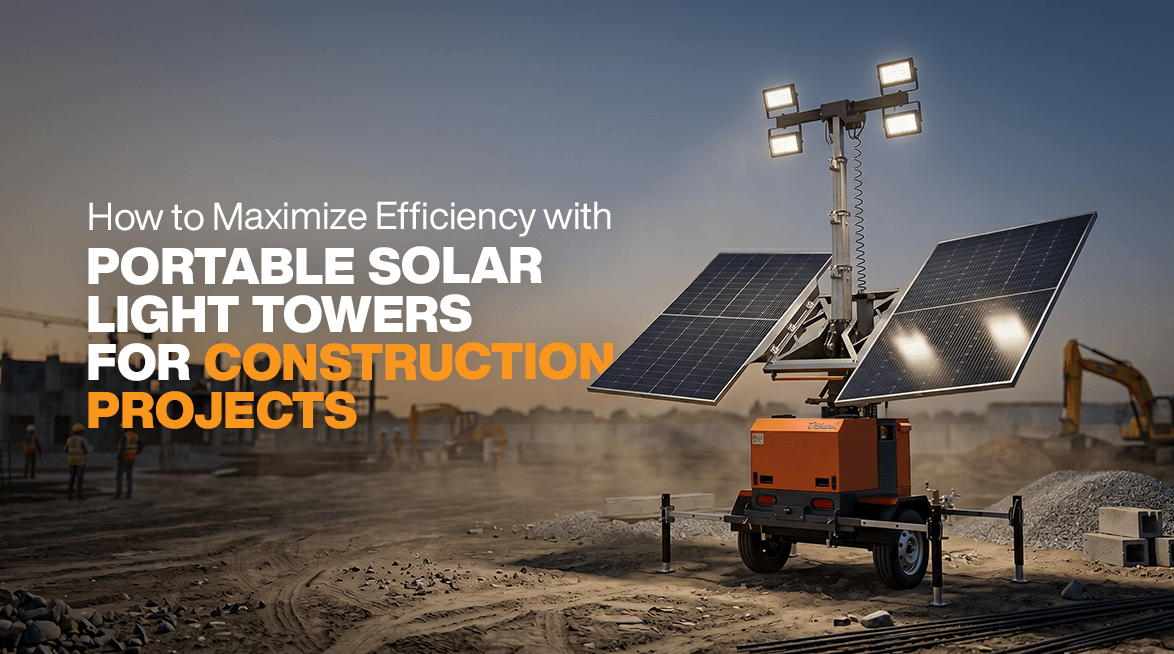
Olikara’s hybrid towers, like the Qube Solar and Qube Power Max Hybrid, are designed to be as energy efficient as possible, while also being reliable. These systems are a combination of solar panels, battery storage, and diesel backup, and as such are ideal for construction sites with fluctuating sunlight.
An example is Qube Solar with two 550 W bifacial solar panels (1100 W total) and a 10.8 kVAh battery pack, which provides more than 10 hours of lighting on a single solar charge.
It also includes:
- Adjustable LEDs to increase runtime
- Tilt-adjustable panels to achieve maximum sun capture
- Silent and emission-free operation
Higher-demand projects can be supported by Qube Power Max Hybrid, which is equipped with a 7.2 kVAh battery with diesel backup and and provides 4000 sq. m. of LED coverage with 6 × 200 W lights.
Such a combination guarantees constant light, even in low sunlight, making hybrid towers an effective option for highways, bridges, and other large infrastructure projects.
Diesel Towers: Consistent for Heavy-Duty Operations
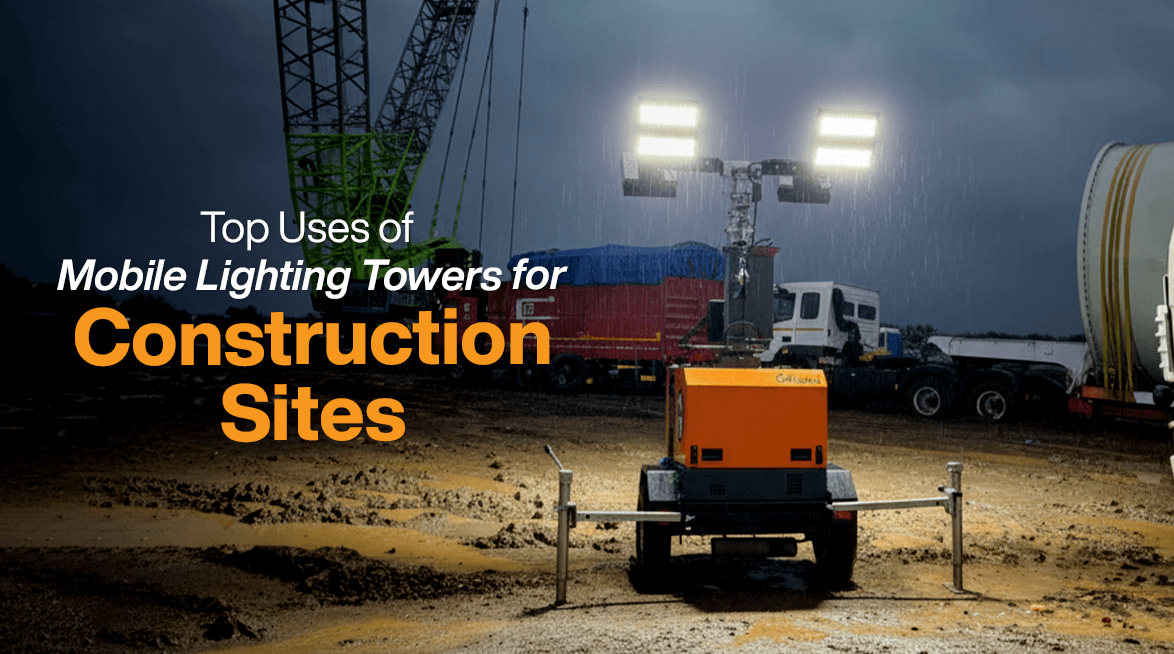
Diesel-based systems such as Qube Power Max are designed for high output and continuous lighting. They have a large diesel tank, water-cooled engine, and can run for up to 100 hours, making them suitable for the mining and large-scale construction industry.
They provide excellent light coverage (up to 7500 sq. m), but are highly dependent on fuel, making them less cost-effective in the long term than a hybrid system.
Grid-Powered Towers: Efficient Where Power is Available
The grid-based towers, like Qube Grid Max, are most appropriate for urban or industrial environments with stable electricity. They provide 6 × 400 W LED lights, up to 8000 sq. m coverage, and operate with zero noise and emissions.
They also have hydraulic masts and can be integrated with other equipment, making them highly versatile.
Final Insight
Although diesel and grid towers may be suitable for certain needs, hybrid (solar-powered) ones evidently provide the optimal balance of efficiency, sustainability, and reliability, which is why they are the preferred option in construction projects today.
Bringing Efficiency with Performance
Maximizing efficiency with portable solar light towers is a question of developing a well-integrated lighting strategy. While it may be as simple as choosing the appropriate combination of diesel, hybrid, and grid-powered towers, each aspect works together to make operations more cost-effective, safer, and more productive.
Hybrid (solar) towers, specifically, serve as the foundation of this strategy by reducing dependency on fuel while ensuring reliable operation.
This shift is already evident across the industry. A market report indicates that the global solar light tower market is expected to grow at a CAGR of over 4.32 percent, fueled by the construction industry’s demand for sustainable and cost-effective lighting solutions.
What this means for construction companies is clear: those who adopt a balanced, as well as technology-driven lighting approach are not only reducing operational expenses but also future-proofing their projects against rising fuel costs and environmental regulations.
Conclusion
Maximizing efficiency using portable solar light towers is not about one decision, but about developing a system. Whether it is strategic placement, technology choice, scheduling, or cost management, each contributes to optimized performance.
Construction firms adopting this holistic approach are not only saving money but also improving safety, sustainability, and project schedules.
In case you are seeking to revolutionize your construction lighting approach, it is important to associate with reputable portable solar light tower manufacturers. Lighting solutions provided by Olikara Lighting Towers, one of the trusted portable solar light tower suppliers, demonstrate how lighting innovation can directly benefit operational efficiency and long-term profitability.
| Ready to make your construction site smarter with better lighting solutions?
Explore Olikara’s portable solar light towers range. Contact now! |
FAQs
1. What is the benefit of portable solar light towers in enhancing construction efficiency?
They remove fuel dependence, lower operational expenses, and facilitate safe night-time work, resulting in quicker and more efficient project delivery.
2. Can portable solar light towers be used in all construction sites?
Yes, particularly on remote, urban, and environmentally sensitive projects. Hybrid models ensure performance in low sunlight conditions.
3. What should I look for in portable solar light tower suppliers?
Focus on product reliability, battery capacity, after-sales services, and intelligent features like automation and remote monitoring.
4. Will solar light towers be able to substitute the diesel-powered towers completely?
Yes, in most cases. However, high-load or continuous operations might still require hybrid or engine-powered towers.