Which is the better choice for your next lighting project: an electric light tower or a diesel light tower? This decision depends on several aspects, such as availability of electricity, required operating hours, site conditions, and operational expenses.
Diesel generators operate well in locations with no electrical supply, while electric lighting towers are suitable when there is a continuous supply of electricity.
Understanding Electric and Diesel Light Towers
Electric light towers and diesel towers are commonly used for outdoor and industrial lighting. The diesel tower produces electricity to light up the area from its generator engine. It is especially beneficial for remote construction sites, mining areas, road construction, and other infrastructure projects where grid power is either not available or not reliable.
An electric light tower refers to a grid-powered model that draws electricity from an external supply. It is compatible with existing construction sites, industrial buildings and workshops, as well as event venues that have a reliable electrical power supply. It eliminates the need to run an onboard diesel generator for lighting requirements.
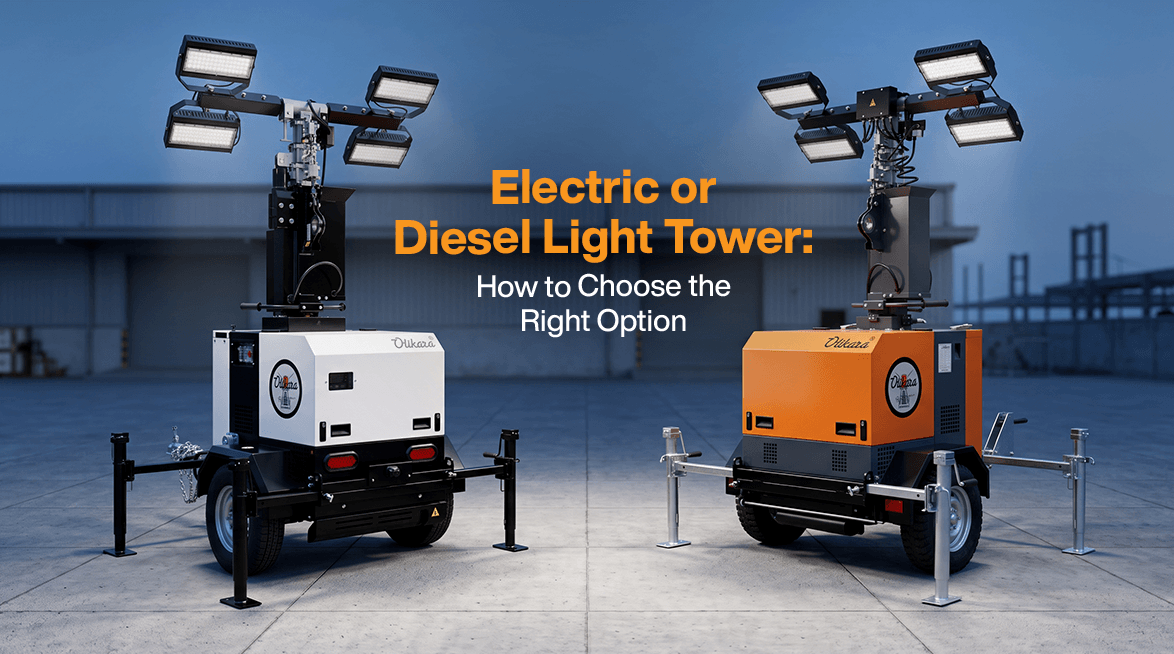
For example, Olikara’s Qube Power is an engine-powered option, while its Qube Grid Base/Trailer is designed to operate using an external grid supply. Both types of light towers can illuminate worksites, but their suitability depends on the site’s power supply, lighting needs, and operating conditions.
Electric vs Diesel Light Tower: Comparison
| Comparison factor | Electric light tower | Diesel light tower |
|---|---|---|
| Power source | External electrical grid | Diesel-powered engine and generator |
| Site suitability | Locations with reliable electricity | Remote or off-grid locations |
| Fuel requirements | No diesel required for lighting | Requires diesel fuel |
| Noise | Generally quieter because there is no onboard generator running | Engine and generator produce operational noise |
| Runtime | Depends on the continuity of the electrical supply | Depends on fuel capacity, consumption, and operating conditions |
| Operating costs | Electricity charges and maintenance | Fuel, engine servicing, and maintenance |
| Mobility | Best where power access is available at the required location | Suitable for sites where independent operation is essential |
Electric light towers can have lower operating costs when a reliable power supply is available, as they do not require diesel fuel. Their maintenance requirements and overall costs depend on the tower design, power source, and operating conditions. Diesel light towers generate their own electricity, making them suitable for sites without access to a reliable grid connection, although fuel consumption and engine maintenance add to operating expenses.
When Should You Choose a Diesel Light Tower?
Diesel light towers are ideal for projects where access to a fixed power supply is not certain. Such lighting is frequently essential at construction sites, in mining areas, at locations away from the electrical grid, or in highway development projects.
If the equipment is kept in good operating condition and regular fuel is supplied, then an engine-powered tower works well. Thus, diesel-powered light towers are suitable for worksites that require flexible operating hours, including night-time operations.
When selecting a diesel model, consider:
- There is no dependable grid supply on the worksite, or there is no practical way to connect to the grid.
- Lighting must be switched from one work zone to the other during a project.
- Longer illumination without a fixed electricity source is desired for operations.
- Fuel storage, refueling, and regular engine maintenance facilities are in place.
Also, consider the cost of the fuel, maintenance of the diesel equipment and the emissions and noise of the operating engine. All those factors become important when towers are operated for a long time and near residential areas, hospitals, and noise-sensitive institutions.
When is an Electric Light Tower the Better Choice?
For sites with an existing electrical connection, it is appropriate to use grid-powered light towers. In industrial and developed areas, lighting equipment can be used without an onboard diesel generator that powers the lights.
Electric towers are typically used where:
- A suitable power source is available within or close to the area where lighting is needed.
- The equipment will be in a controlled working area for long periods.
- The site can provide a safe environment for the placement of power cables and appropriate electrical protection and distribution equipment.
Also, the market for electric light towers is growing and is projected to reach USD 819.5 million by 2034. The only limitation is dependence on the external supply. If no other source of power is supplied or there is no back-up, lighting can be affected during a power outage.
What About Hybrid Light Towers?
The decision is not limited to only diesel or electric lighting towers. Hybrid lighting towers combine different power sources, often using batteries alongside a generator, depending on the system’s configuration. These systems are especially important for construction, mining, and infrastructure projects that involve long operation time.
Their performance is defined by battery capacity, charging facilities, operating modes, and lighting needs. Before you choose a hybrid setup, estimate energy cost and savings, space requirements, energy availability, and upkeep costs.
This will help you get a realistic view of the hybrid operation in terms of operational capabilities, fuel expenditure, and maintenance.
How to Compare the Total Cost of Ownership?
It is not just the tower price that makes it more or less economical. The actual calculation must take into account all costs throughout the period of usage, including energy costs, servicing, transportation, and downtime.
The main recurring costs for diesel towers are fuel, engine servicing, as well as filters and engine lubricants. The following costs are used for electric models: electricity consumption, power distribution, and electric maintenance. For hybrid lighting towers, operating costs may include fuel, engine maintenance, battery replacement, and charging electricity, depending on the system’s configuration and operating mode.
The best method to use is to make an estimate of the operating-hour cost based on actual site conditions. A tower used only a few nights a month may have very different operating costs from one used every night on a large infrastructure project.
Before making a decision, compare:
- Diesel operation: fuel consumption per hour, expected operating hours, servicing intervals, fuel delivery, and potential downtime.
- Electric operation: electricity tariff, load of lighting, availability of the supply, cable requirements, distribution, and electrical maintenance.
If running a hybrid system, consider the battery replacement assumptions, charging requirements, and percentage of operating time in each mode. Instead of industry averages or estimates for typical models, request model-specific values for fuel consumption and/or electric load from potential suppliers.
For comparing the two types of light towers from diesel light tower manufacturers and electric light tower manufacturers, compare them over the same operating hours, lighting requirements, and project length. This provides a more accurate comparison of the total cost of ownership rather than focusing solely on the initial purchase price.
Conclusion
Choosing between electric and diesel light towers requires assessing the site’s power supply, expected operating hours, mobility needs, maintenance requirements, and overall operating costs.
Diesel-powered models can be used in remote areas but suitability still depends on fuel logistics, operating duration and site conditions. Whereas grid-powered towers can be used where reliable electric power is easily available. For applications that require fuel efficiency and operational flexibility, hybrid models are also available.
Olikara Lighting Towers provide engine-powered, grid-powered, and hybrid options. As experienced light tower manufacturers, we can help you choose the right lighting tower for your site conditions and operational needs. Contact us to discuss your project requirements.
FAQs
1. Which is better: an electric or diesel light tower?
Electric towers can be used at sites that have stable access, while diesel towers are needed in places where electricity supply is unreliable.
2. Are electric light towers cost-effective to operate?
They are usually not costly if grid electricity is readily available, but it depends on energy tariffs, usage hours, and maintenance costs.
3. Is it possible to run diesel light towers all night?
Yes, depending on the model’s fuel consumption, operating conditions, and maintenance requirements.
4. Can Hybrid Light Towers be used in construction sites?
Absolutely, hybrid towers can work for construction sites that require long periods of operation with battery and engine backup power.